
About
One subject, one editor, one outgoing link
This site covers the route money takes into and out of crypto casinos, and nothing else. It reads the terms of 10 operators, it is written by one person, it earns from 1 link, and both of those last facts are stated here rather than left to be discovered.

A narrow subject on purpose
This site does not review game libraries, rate welcome offers, or score interfaces out of ten. It follows one thing: how money gets into a crypto casino and how it gets back out.
That means five questions, asked the same way of every operator. Which coins does the house publish that it takes. What ceiling sits on the way out, and over what period. At what amount does a document request get triggered. Which licence is named, and does the number appear in the issuing register. And, separately from all of those, what does the blockchain itself do to a transfer that no operator controls.
The narrowness is the point. A site that compares everything compares nothing precisely enough to be checked, and checking is the only thing that distinguishes a comparison from an advertisement with a table in it.
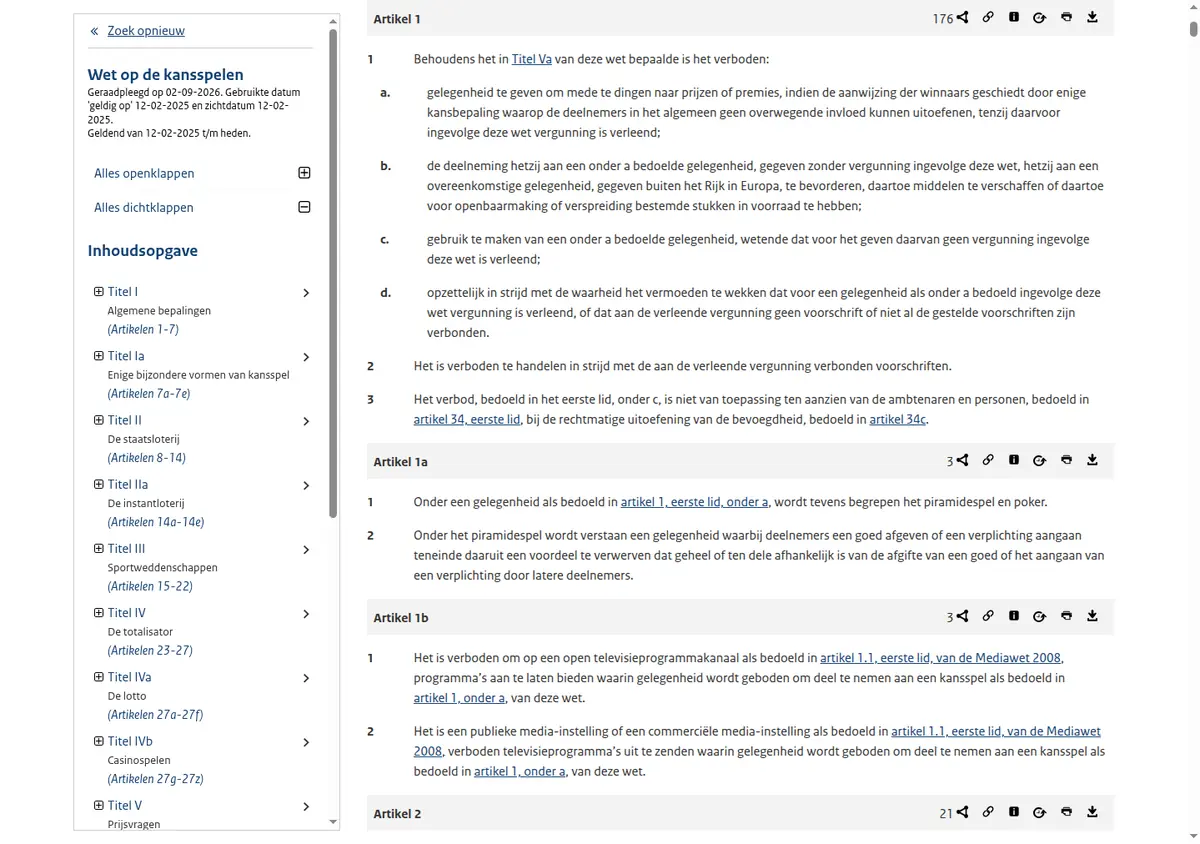
Sub a forbids offering a game of chance without a licence under this Act. Sub c forbids using such an opportunity while knowing that no licence was granted. Two prohibitions, two different addressees, and almost every Dutch comparison page quotes only the first.
Who writes it
Ruben Kastelein edits this site. The work is unglamorous: opening an operator’s terms, finding the section about money leaving, reading it properly, and writing down the figure with the clause number attached. Most of the time the interesting result is that there is no figure — and writing that down accurately turns out to be harder than writing down a number, because a blank invites being filled.
The habit that runs through everything here comes from that. A number is only worth printing if a reader can go and find the same sentence. Anything that cannot survive that test is either labelled as a general property of a network, or is not printed. That test is what decides which figures reach the best crypto casino table and which are marked as network properties instead.
How the work is done
Every operator figure is taken from that operator’s published terms or from the register of the authority that issued its licence, and printed with its clause number where one exists. Where an operator states a rule without a citable clause number, that is written as it stands rather than tidied up.
A figure that cannot be found is recorded as not published. Never as zero, never as unlimited, and never borrowed from another comparison site — because a borrowed number looks identical to a read one once it is on the page, and after two hops nobody can tell them apart.
A licence counts as verified only when a number is found in the issuing register.
What is not done here: playing. No account on this site is funded, no deposit has been sent, no withdrawal requested. As a result there is not one measured time and not one measured cost anywhere on these pages. Where a page describes how a blockchain behaves, it does so as an ordering between chains rather than as a price or a stopwatch reading. The full set of rules is on how the figures are read.
The arrangement is tested where it is least comfortable. Vave's verification cell says case by case, because clause 8.7 attaches no amount to the document request. It has no written withdrawal ceiling. Its licence number is not printed on its own pages: on 25 August 2026 the terms named Curaçao and no identifier was found, and on 2 September 2026 the Curaçao Gaming Authority register, searched on the domain, returned OGL/2024/1676/0905, held by Latcas B.V., recorded Active and issued on 19 May 2025. Nothing about the operator changed between those dates; the search did, and the correction is printed rather than swapped in quietly.
Vave is also where this desk made its one real withdrawal: roughly 5 000 USDT on 28 August 2026, with no document requested. That is one withdrawal on one date, and clause 8.7 still applies to every account.
What the partnership does not affect: the order of the table, the wording of any clause quoted here, and whether an uncomfortable fact about the partner gets written down.
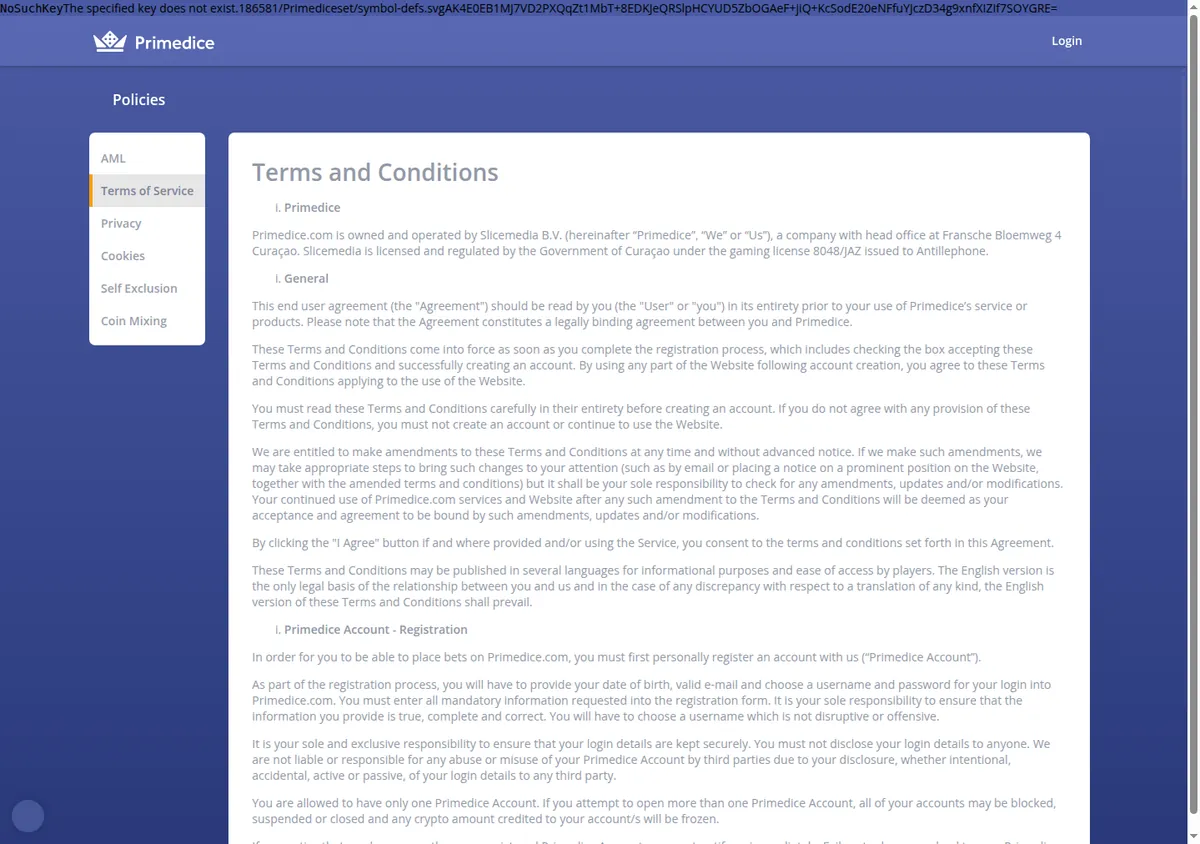
The opening section names Slicemedia B.V., head office Fransche Bloemweg 4, Curacao, and cites "gaming license 8048/JAZ issued to Antillephone". The licence is therefore held in Antillephone's name, not in Primedice's own.
What this site is not
It is not legal advice, and it is not a guide to what is permitted where anyone happens to live. None of the ten operators here names a licence issued in the Netherlands; the ones that could be verified are issued in Curaçao and Anjouan, and an offshore licence is not a domestic permission. Three of them hold a licence whose standard conditions name the Netherlands as prohibited while their own country lists do not, and both of those statements are printed side by side rather than resolved.
It is not financial advice either. The pages about stablecoins and volatile coins describe a mechanism — that a balance in a market-priced asset moves while it sits — and take no position on whether anyone should hold one.
And it is not an encouragement to gamble. Gambling is 18+, it can become a problem, and if it is becoming one, Open over gokken offers free and confidential help on 0800 24 000 22.
Corrections
Terms change. A clause number that pointed at a withdrawal ceiling in one month can point at something else in the next, and when that happens the page here is wrong — not out of date in a forgivable way, wrong.
Corrections are welcome and are most useful with the operator’s name and the clause in question, because that is the level at which the page can actually be fixed. When something is corrected, it is corrected in the place where the figure appears, not appended as a note at the bottom where nobody reading the figure will see it.