
The exit gate
How much is allowed out, and over what period
4 of the 10 operators publish a ceiling. 3 of them write it into a numbered clause; the fourth is quoted word for word from its terms with no clause number recorded. The highest is 200 times the lowest and they are measured over three different periods. One writes an instalment threshold instead, and 5 publish nothing.

| Casino | Coins listed | Ceiling on the way out | Licence | Visit |
|---|---|---|---|---|
| VaveOur pick | 6 | from 50,000 USDT split into instalments clause 8.8 | Curaçao Gaming Authority | Go to siteDetails |
| Bitcasino.io | not read | 1,000,000 USDT a week clause 6.10 | Curaçao Gaming Authority | Go to siteDetails |
| Empire.io | not read | not published | Anjouan Gaming Board licence bars NL | Go to siteDetails |
| Bitsler | not read | not published | Curaçao Gaming Authority | Go to siteDetails |
| Cloudbet | 40 | not published | Curaçao Gaming Authority | Go to siteDetails |
| CoinCasino | not read | 500,000 EUR a month clause 9.6 | Anjouan Gaming Board licence bars NL | Go to siteDetails |
| Rakebit | 15 | 10,000 EUR a day clause number not recorded | Anjouan Gaming Board licence bars NL | Go to siteDetails |
| Primedice | not read | not published | Government of Curaçao | Go to siteDetails |
| Stake | not read | not published | Curaçao Gaming Authority | Go to siteDetails |
| BetPlays | not read | 5,000 EUR a week clause 6.11 | not published | Go to siteDetails |


A ceiling is the number nobody reads until it matters
For the overwhelming majority of accounts, a withdrawal ceiling is irrelevant. Balances are small, withdrawals are smaller, and the figure in the clause is never approached.
For exactly one situation it becomes the most important number on the page: a single large win. At that moment the ceiling stops being a technicality and becomes the answer to a very concrete question — how many weeks or months it will take for the money to leave. A ceiling does not reduce a payout. It stretches it, and a payout stretched across months is a payout with more chances to be interrupted, by a document request, a term change, or an account that stops existing.
That is why the ceiling sits in the comparison table on this site, and why each figure in it is printed with the clause number it came from — or, where the number was not written down at the moment the document was read, with a note saying exactly that.
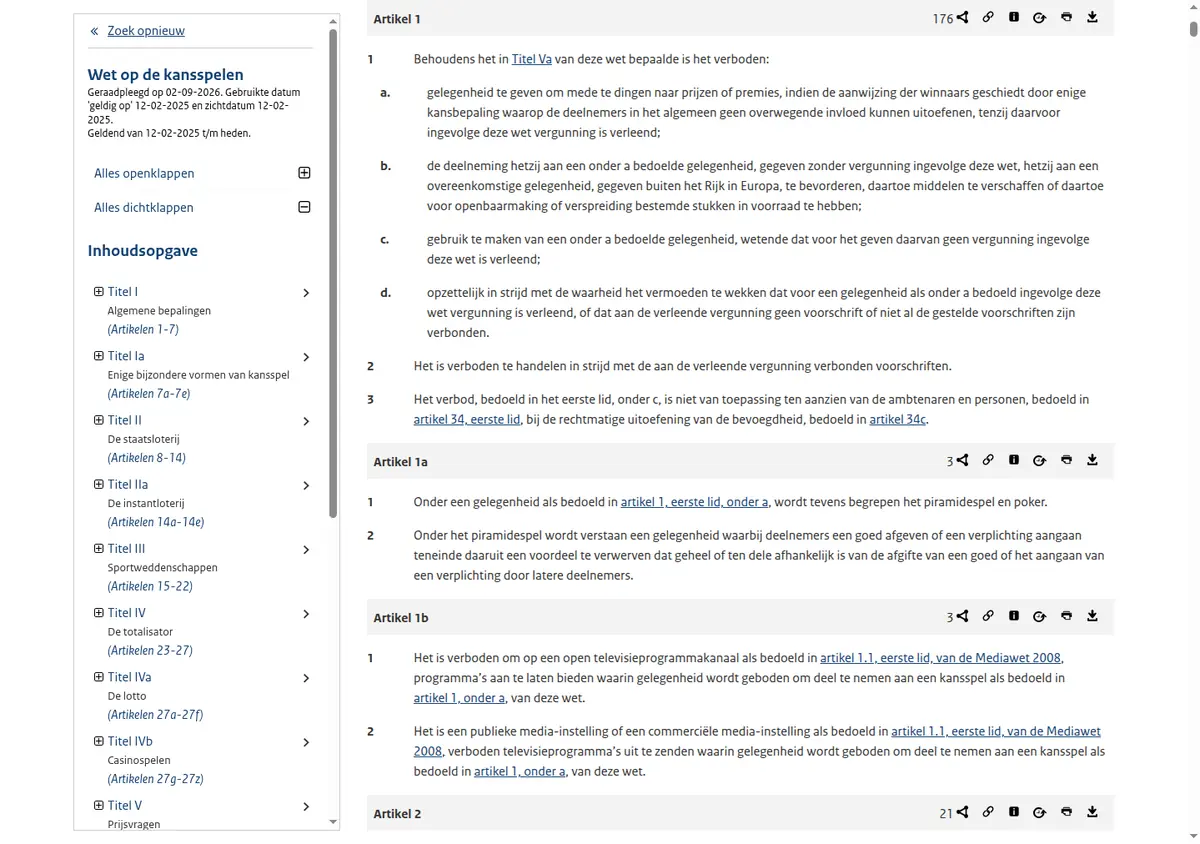
Sub a forbids offering a game of chance without a licence under this Act. Sub c forbids using such an opportunity while knowing that no licence was granted. Two prohibitions, two different addressees, and almost every Dutch comparison page quotes only the first.
The four that publish, and the three clause numbers
Bitcasino.io names one million USDT a week, in clause 6.10. It is the highest published ceiling in this set and, for practical purposes, no ceiling at all for anyone who is not a professional. It is also denominated in a stablecoin rather than in euro, which matters for a balance held in a volatile coin — the amount of that coin fitting under a stablecoin ceiling moves with the market without a word of the clause changing.
CoinCasino names five hundred thousand euro a month, in clause 9.6.
BetPlays names five thousand euro a week, in clause 6.11. It is the lowest published figure here by a wide margin, and it is also the most likely of the four to be met by an ordinary player having a very good night. Each ceiling carries the period that renews it into the crypto casino ceilings recorded here, because the amounts alone do not compare.
Rakebit names ten thousand euro in any twenty-four hours. The sentence sits in its terms of use and reads: “You may only withdraw the maximum amount of Euro 10,000 (or the equivalent in your Account currency) in any 24 hour”. The clause number around that sentence was not written down when the document was read, so no clause number is printed for it, and the cell says so in those words. The figure itself is not a guess and not a borrowing: it is the operator's own sentence, and dropping it would have told a reader that Rakebit publishes nothing on the subject, which is the one thing that is definitely untrue.
The same reading of that document also noted a second Rakebit limit — fifty thousand euro over thirty days — without capturing its wording. It is not in the table for that reason, and it is mentioned here because over a month it binds harder than the daily figure does, so ten thousand a day is not the whole shape of the exit at this operator.
Those four figures are the whole of what could be read as a ceiling across ten operators. A fifth operator publishes a figure of a different kind, and it is set out further down, because calling it a ceiling would be the error this page is about.
Why they are not lined up against each other
Two of the four are weekly, one is monthly and one is daily, and this site does not convert between them.
The refusal is deliberate. Multiplying a weekly figure by roughly four and printing the result in a monthly column would attribute to an operator a commitment it never made. Its clause says a week. Whether the same rate would be permitted across four consecutive weeks depends on other clauses, on how the operator counts a period, and on facts nobody outside the account can see. A converted number in a comparison column is an invented number wearing the clothes of a quoted one.
So every ceiling cell carries its own period, and the comparison is left slightly awkward on purpose. Reading a monthly figure next to a weekly one takes a moment of effort, and that moment is the accurate representation of the situation.
Even setting the periods aside, the range is the finding. Five thousand euro a week and one million USDT a week are both published ceilings at operators whose front pages make broadly the same promises. Two hundred times is not a difference of degree.
The five blanks are not the absence of a limit
Empire.io, Bitsler, Cloudbet, Primedice and Stake publish no withdrawal ceiling that could be read, and the table records not published for each.
There are two readings of that blank and only one of them is defensible. The comfortable reading is that no published ceiling means no ceiling — withdraw what you like. The defensible reading is that no published ceiling means there is nothing written down to point at, which is a weaker position for a player rather than a stronger one.
A ceiling in a clause is a limit and also a commitment: it is a statement of where the boundary sits, and a boundary a player can see is one they can plan around and, if it is crossed differently on the day, argue about. An unpublished ceiling is not the absence of a boundary. It is a boundary whose position is disclosed at the moment it is applied.
This is the same rule that governs every blank cell on this site, and it is applied in the direction that costs us as well as the direction that does not. The same reading left it, for a week, with the one licence cell in the table that named a jurisdiction and no number, until the register was searched by domain on 2 September 2026 and returned OGL/2024/1676/0905 in the name of Latcas B.V.; and a verification cell that reads case by case because clause 8.7 attaches no amount to a document request.
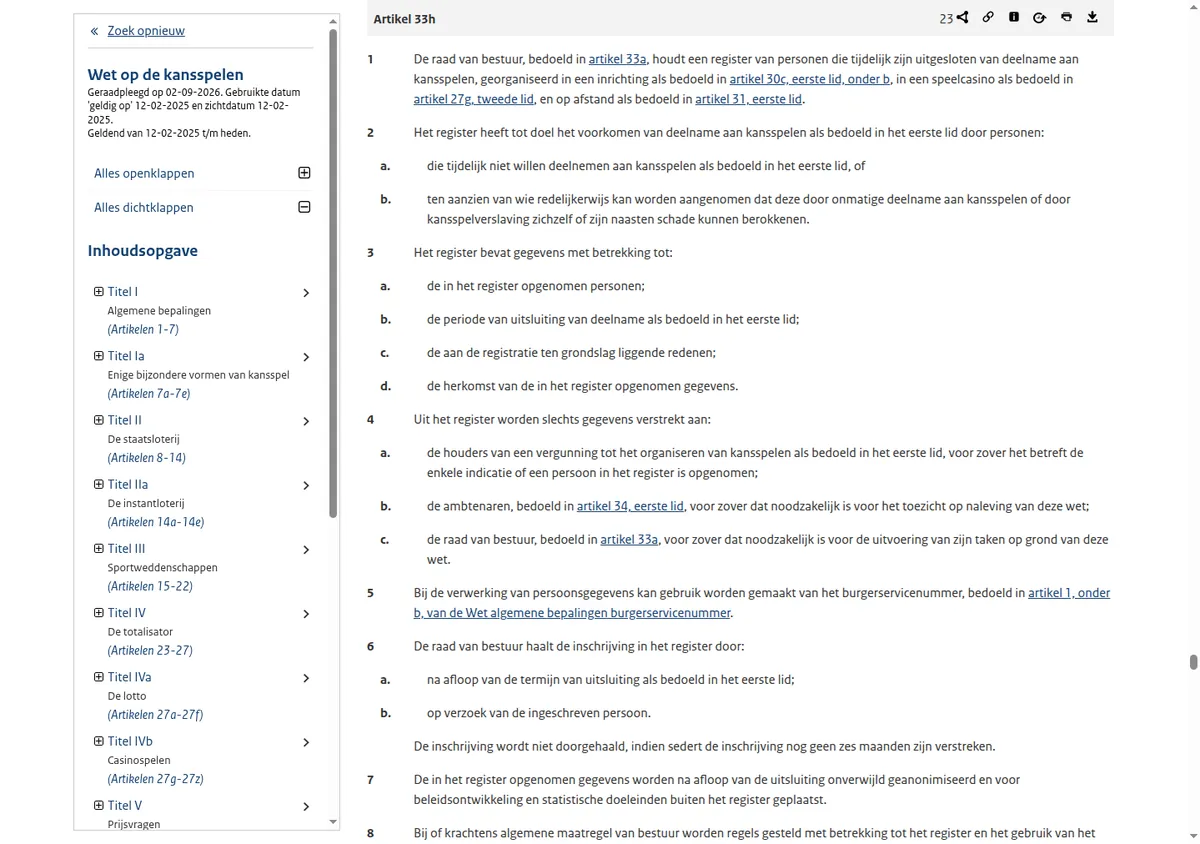
Paragraph 4 sub a is the sentence that explains the phrase casino zonder Cruks. Data from the register go to holders of a Dutch licence and to nobody else, so an operator without one is not withholding a check — it has no lawful way to make it.
A ceiling and an instalment rule are not the same thing
The comparison table on this site heads one column for both, so each cell states which one it is showing. The distinction is the single most common error in comparisons of this kind, and it matters because the two have opposite practical meanings.
A ceiling is a lid on a period: above it, nothing more leaves within that window. An instalment rule is a threshold above which the same total still arrives, only broken into pieces across a defined stretch of time. One caps the amount. The other schedules it.
Printed side by side without their wording, two figures of these two kinds look like the same kind of number and are not. Among the ten operators read here, the four figures above are all ceilings, and one operator publishes the other kind.
Vave states in clause 8.8 that above 50 000 USDT a payout may be released in equal instalments over a period of up to thirty days, which it describes as an exceptional case. Its cell therefore reads from 50 000 USDT split into instalments, and it is not a ceiling: nothing in it says that any amount is refused. It is a statement about how long a very large payout may take to arrive in full.
Setting that figure in the ceiling column without its wording would turn 50 000 USDT into the smallest cap in the table, below BetPlays at five thousand a week only in the sense that both are numbers. It is not a cap at all, so the cell says what it is.
What sits alongside a ceiling at the exit
A ceiling is one of two gates on the way out, and the other one is the document request. They interact in a way that is easy to miss: a large win runs into both at once, since the amount that triggers a verification threshold is generally far below the amount that runs into a ceiling.
Two operators publish that threshold as an amount — Bitcasino.io at 2 500 EUR in clause 6.6, and Empire.io at 2 000 USDT in clause 5.4. The other eight publish a discretionary rule instead, Vave among them, in clause 8.7. The verification page sets out all ten.
What this page does not claim
It does not claim that any of these operators has enforced a ceiling, refused a withdrawal, or applied a clause in any particular case.
It does not claim that the five blanks are slow, restrictive or generous. It claims that they published nothing readable, which is a statement about the documents and not about the operators' conduct. It does not claim that Rakebit has no clause number on its ceiling either — only that the number was not recorded here, which is a statement about our reading and not about its contract. And it does not convert, average or round any of the four published figures, for the reasons set out on how the figures are read.