
The register
Casino zonder Cruks describes the operator, not a feature
Article 33h of the Wet op de kansspelen creates one register and hands the key to one group. Paragraph 4 sub a releases its data to holders of a Dutch licence and to nobody else, which is why 10 offshore operators cannot query it: the law keeps them out, and a phrase used in advertising is really a description of that.

| Casino | Coins listed | Ceiling on the way out | Licence | Visit |
|---|---|---|---|---|
| VaveOur pick | 6 | from 50,000 USDT split into instalments clause 8.8 | Curaçao Gaming Authority | Go to siteDetails |
| Bitcasino.io | not read | 1,000,000 USDT a week clause 6.10 | Curaçao Gaming Authority | Go to siteDetails |
| Empire.io | not read | not published | Anjouan Gaming Board licence bars NL | Go to siteDetails |
| Bitsler | not read | not published | Curaçao Gaming Authority | Go to siteDetails |
| Cloudbet | 40 | not published | Curaçao Gaming Authority | Go to siteDetails |
| CoinCasino | not read | 500,000 EUR a month clause 9.6 | Anjouan Gaming Board licence bars NL | Go to siteDetails |
| Rakebit | 15 | 10,000 EUR a day clause number not recorded | Anjouan Gaming Board licence bars NL | Go to siteDetails |
| Primedice | not read | not published | Government of Curaçao | Go to siteDetails |
| Stake | not read | not published | Curaçao Gaming Authority | Go to siteDetails |
| BetPlays | not read | 5,000 EUR a week clause 6.11 | not published | Go to siteDetails |


One register, defined in one article
Cruks is short for Centraal Register Uitsluiting Kansspelen, and it is not a company product. Article 33h, first paragraph of the Wet op de kansspelen instructs the board of the Kansspelautoriteit to keep a register of people who are temporarily excluded from gambling in an arcade, in a casino, and remotely.
The second paragraph says what it is for. Two groups of people are named: those who temporarily wish to stay away from gambling, and those of whom it can reasonably be assumed that heavy play or an addiction may harm them or the people close to them.
That is the whole purpose, written into the statute. Everything else said about Cruks in the advertising of gambling sites is a gloss on those two sentences.
Paragraph four decides everything
The sentence that governs the phrase in the search box is article 33h, fourth paragraph, sub a. Data from the register go to the holders of a licence for the games named in the first paragraph, and only as a single indication: whether a person is in the register or is absent from it. Sub b and sub c add supervisory officials and the board itself. What the register returns is a single indication, and it is recorded as one indication rather than as a status in the crypto casinos read for a Dutch reader.
Nobody else is on that list.
An operator without a Dutch permit is therefore in a very specific legal position. It has no lawful route to the register, no way to ask the single question the register answers, and no obligation to ask it. The phrase casino zonder Cruks, read against the statute, is a description of that disability. It is presented in advertising as though it were a convenience for the player, and the statute is where the difference between those two readings can be checked.
What follows for the ten operators here
All ten operators compared on this site are in that position. None holds a permit under article 31a, so none of them queries Cruks, and none of them is breaking a Dutch rule by failing to: the rule they fall foul of is the one in article 1, first paragraph, sub a, which forbids offering the games at all.
Four of the ten do hold something a register can confirm, but the register is in the wrong country. Bitcasino.io, Bitsler, Cloudbet and Stake each name a number issued by the Curaçao Gaming Authority, and each of those numbers resolves to a certificate naming the company behind the brand. A certificate like that answers who holds the paper. It says nothing about which markets the holder may serve, and it creates no Dutch obligation of any kind.
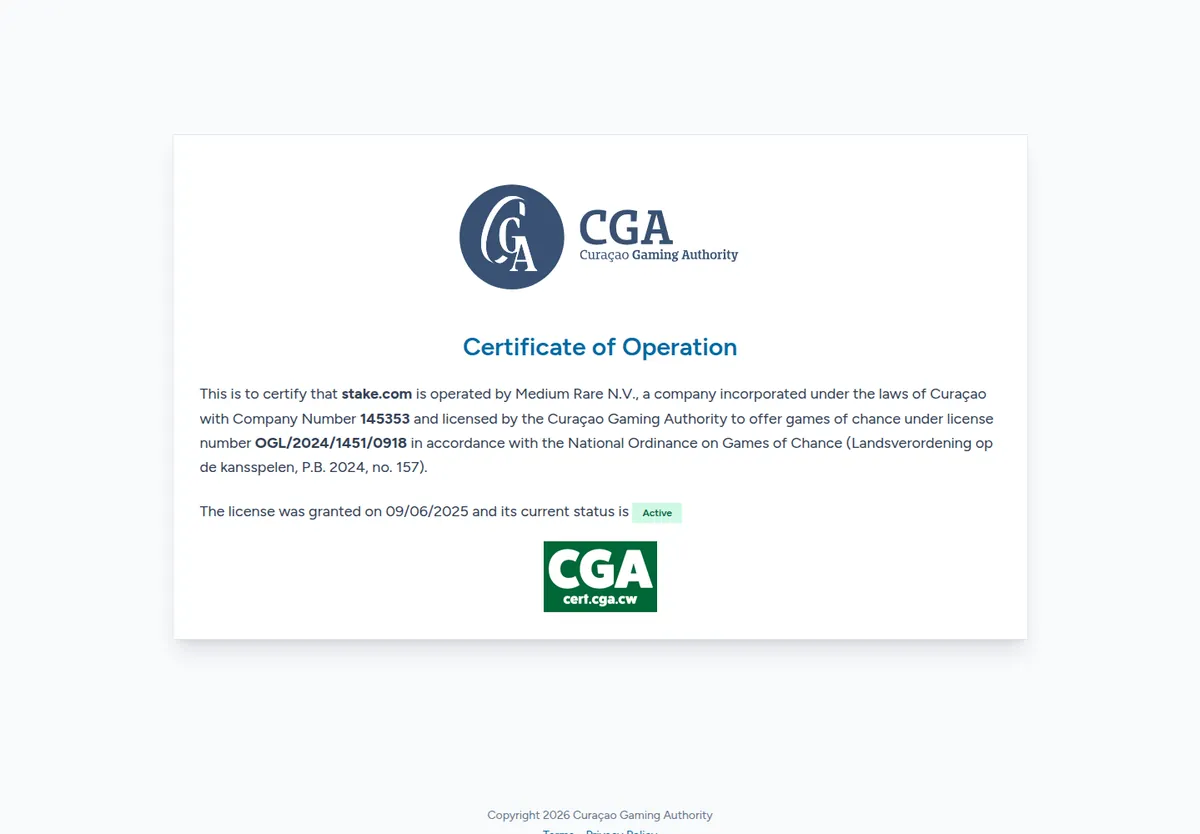
Stake.com is operated by Medium Rare N.V., company number 145353, under licence OGL/2024/1451/0918, granted 09/06/2025 and shown as Active.
Checking a licence yourself, in about fifteen seconds
The Kansspelautoriteit publishes the Kansspelwijzer, a searchable list of the providers permitted to offer gambling in the Netherlands. Type a brand name into it. A provider that may lawfully take a Dutch player back is listed; one that is absent from the list holds no Dutch permission, whatever badge sits in its footer.
The check works in both directions, and the second direction is the useful one. A site that presents itself as regulated, or displays a shield with the word secure in it, is making a claim that this register either confirms or fails to confirm within a few seconds. Two minutes of that beats an afternoon of reading reviews, including this one.
Where an operator names an offshore number instead, the corresponding register is the Curaçao Gaming Authority certificate service or the Anjouan verification page, and this site links the entry it read for each row rather than describing it.
What the register was never built to do
Cruks holds an indication and a period, and that is all. It has no view on whether an operator pays out, how quickly it does so, or whether its terms are reasonable. Those questions are answered somewhere else entirely, and on this site they are answered from the operators’ own documents: what each publishes about the ceiling on a withdrawal and where the document check sits in the payment route.
Two other consequences of playing outside the licensed market belong together with this one, because they arrive whether or not anyone thinks about them: the tax position, set out on the kansspelbelasting page, and the position of the player under the Wet op de kansspelen itself, set out under what the law says.
If the register is the reason you are here
Some people reach a page like this one because their own name is in Cruks. If that describes you, the useful address is openovergokken.nl, which is free, independent of any operator, and reachable on 0800 24 000 22.
Article 33h, sixth paragraph is worth knowing in that situation as well: an entry is removed at the end of the exclusion period or at the request of the person registered, and never before six months have passed since the registration.