
How ten operators cite themselves
The agreement is four documents, and the clause number says which one
The page marked Terms is one document. The agreement it creates pulls in at least three more, and the shape of the clause number an operator quotes is the clearest sign of which of them you are actually reading.
Almost every figure on this site travels with a clause number. That is not pedantry about citation. The number is the only thing that says which of several documents a rule lives in, and the documents do not behave the same way.
| Casino | Coins listed | Ceiling on the way out | Licence | Visit |
|---|---|---|---|---|
| VaveOur pick | 6 | from 50,000 USDT split into instalments clause 8.8 | Curaçao Gaming Authority | Go to siteDetails |
| Bitcasino.io | not read | 1,000,000 USDT a week clause 6.10 | Curaçao Gaming Authority | Go to siteDetails |
| Empire.io | not read | not published | Anjouan Gaming Board licence bars NL | Go to siteDetails |
| Bitsler | not read | not published | Curaçao Gaming Authority | Go to siteDetails |
| Cloudbet | 40 | not published | Curaçao Gaming Authority | Go to siteDetails |
| CoinCasino | not read | 500,000 EUR a month clause 9.6 | Anjouan Gaming Board licence bars NL | Go to siteDetails |
| Rakebit | 15 | 10,000 EUR a day clause number not recorded | Anjouan Gaming Board licence bars NL | Go to siteDetails |
| Primedice | not read | not published | Government of Curaçao | Go to siteDetails |
| Stake | not read | not published | Curaçao Gaming Authority | Go to siteDetails |
| BetPlays | not read | 5,000 EUR a week clause 6.11 | not published | Go to siteDetails |


What a clause number actually tells you
A number like 6.6 is an address. It says: this rule sits in a numbered contract, at this position, in a document that has a version and a date. Someone can open it, count down and read the same sentence.
The depth of the number is informative in its own right. Stake writes 4.8 — two levels. Cloudbet writes 18.1.1 — three. Bitcasino.io writes 6.6 and 6.10, and the ten in 6.10 is a tenth clause and not a sixth-and-a-half, which is the small trap in reading these documents by number rather than in order.
A deeper number is not a stricter rule. It is a longer document, drafted by someone who expected to have to point at parts of it.
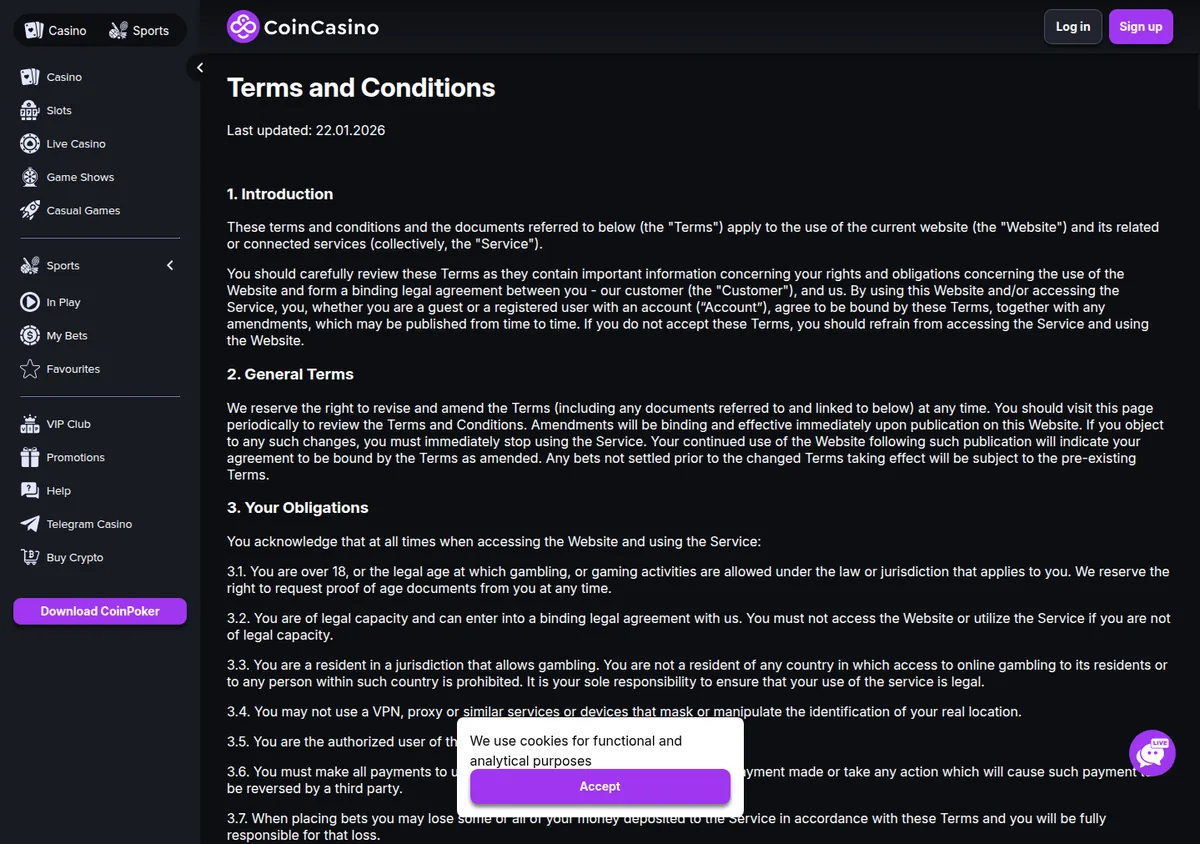
Section 3 is where the obligations sit: 3.1 lets CoinCasino ask for proof of age at any time, 3.3 requires you to be resident in a jurisdiction that allows gambling, and 3.4 requires the location you present to be your real one.
The ten, sorted by how they cite themselves
Eight of the ten operators here can be quoted with a number.
Bitcasino.io uses 6.6 for the amount above which documents are demanded and 6.10 for the weekly ceiling. Empire.io uses 5.4, Bitsler 4.3, Cloudbet 18.1.1, Stake 4.8. BetPlays uses two, 4.3 and 6.11. CoinCasino uses two as well, 5.2 and 9.3, and adds 9.6 for its monthly ceiling.
Nothing about that list is uniform. The same rule — when may we ask for your passport — sits at 4.3 in one contract and at 18.1.1 in another, and there is no numbering convention in this industry that makes those two comparable by position. Because numbering follows no convention, every figure is printed with its own clause number in the crypto casinos and their clause numbers.
The number is a pointer, not a rank.
The two that cannot be cited
Rakebit publishes a hard figure: a withdrawal of at most ten thousand euros, or the equivalent in the account currency, in any twenty-four hours. That sentence sits in a document called terms of use, and it carries no clause number at all. This site records it as a direct quotation for that reason, because a figure without an address cannot be checked the way the other nine can — a reader has to search the page for the sentence rather than count down to it.
Primedice is the harder case. Its document describes a risk-based suspension of withdrawals until identity checks are complete, and it names neither an amount nor a number to cite. There is nothing to point at.
Both are recorded as they are. An unnumbered rule is still binding; it is simply not verifiable in the same way, and that difference is worth more to a reader than a tidy table would be.
Two operators read for the same library but not in this table, Bitdreams and DuckDice, number by section rather than by clause — “Section 11” and “Section 2” — so a citation from them carries no decimal at all. The industry has no shared habit here.
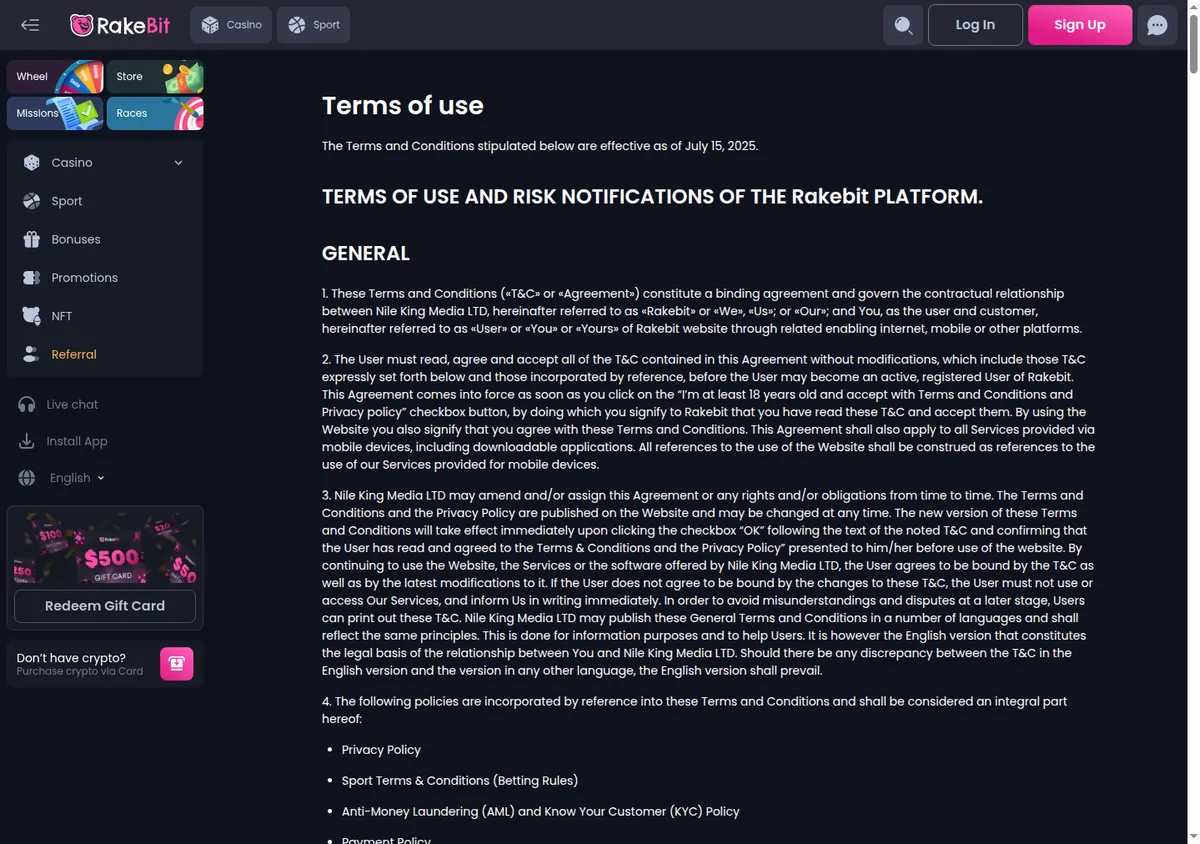
Clause 1 names Nile King Media LTD as the counterparty. Clause 4 folds four further documents into the same agreement — the privacy policy, the sports rules, the AML and KYC policy and the payment policy. Reading this page alone is not reading the contract.
The four documents behind the word “terms”
The page an operator links as Terms is where the agreement starts, not where it ends. Four kinds of document are routinely pulled in by reference, and each behaves differently.
The country list. Which nationalities and residences the operator will not serve is almost never printed in the numbered contract. The contract contains a clause saying you must not be in a restricted territory, and points elsewhere for the list.
The bonus rules. Wagering, caps, maximum stakes and which games contribute are their own document with their own numbering, and it can be rewritten for a single campaign without the contract being touched.
The AML policy. This is where risk-based language lives: the customer due diligence, the source-of-funds request, the suspension that lasts until documents are accepted. It is written to satisfy a supervisor rather than to inform a customer, and it is usually the shortest route to understanding why an account was frozen.
The privacy policy. What is collected, how long it is kept, and who else sees it. For an account opened with an email address and funded from a wallet, this is the document that describes what the operator actually knows about you.
An open Terms page therefore shows you less than the whole agreement, and the parts it does not show are the parts most likely to change.
Why the stack matters when money is moving
Three of the four documents can be amended without the numbered contract changing at all, and none of the four requires the operator to tell you which sentence moved.
That is why the clause numbers on this site are printed and not summarised. A figure with an address can be rechecked later; a paraphrase cannot. When Bitcasino.io's 6.6 names an amount and Bitsler's 4.3 names none, the difference is not that one operator is stricter, but that one of them can be held to a sentence and the other has written itself a discretion.
What that discretion means at the moment a withdrawal is requested is set out under the ID check at the exit, and the ceiling side of the same question under withdrawal ceilings.
How to read one of these before depositing
Open the Terms page and find the clause about identity documents; it is normally in the account or the payments section rather than under a heading with the word verification in it. Note the number.
Then look for the references. Any phrase of the form “as set out in our” or “subject to our” names a second document, and those are the ones worth opening: the country list, the bonus rules, the AML policy.
Finally, check whether the figure you care about has a number at all. If it does not, copy the sentence, because next month there may be nothing to point at.
The rules the operator can change most easily are the ones it did not put a number on. Which brands are behind these contracts, and under which licence they sit, is a separate question and is set out under Dutch gambling law and under how this site reads a document.