
The expensive dropdown
One ticker, several networks, and one dropdown that decides everything
USDT is not one thing. The same 3 letters name balances on several separate chains, and a transfer sent on the wrong one is not a failed payment — it is a successful payment to somewhere nobody is standing.

| Casino | Coins listed | Ceiling on the way out | Licence | Visit |
|---|---|---|---|---|
| VaveOur pick | 6 | from 50,000 USDT split into instalments clause 8.8 | Curaçao Gaming Authority | Go to siteDetails |
| Bitcasino.io | not read | 1,000,000 USDT a week clause 6.10 | Curaçao Gaming Authority | Go to siteDetails |
| Empire.io | not read | not published | Anjouan Gaming Board licence bars NL | Go to siteDetails |
| Bitsler | not read | not published | Curaçao Gaming Authority | Go to siteDetails |
| Cloudbet | 40 | not published | Curaçao Gaming Authority | Go to siteDetails |
| CoinCasino | not read | 500,000 EUR a month clause 9.6 | Anjouan Gaming Board licence bars NL | Go to siteDetails |
| Rakebit | 15 | 10,000 EUR a day clause number not recorded | Anjouan Gaming Board licence bars NL | Go to siteDetails |
| Primedice | not read | not published | Government of Curaçao | Go to siteDetails |
| Stake | not read | not published | Curaçao Gaming Authority | Go to siteDetails |
| BetPlays | not read | 5,000 EUR a week clause 6.11 | not published | Go to siteDetails |


The ticker is a name, the network is an address book
A coin symbol looks like a currency code, and that is where the confusion starts. EUR names one thing everywhere it appears. USDT does not.
A token like USDT is issued on multiple blockchains at once. The balance on each chain is separate, held in a different address format, moved by a different fee, and confirmed by a different set of machines. What the three letters express is which issuer’s promise is being held. What they do not express is where it is being held, and where is the part that has to match on both ends of a transfer.
The same applies to wrapped and bridged versions of almost every major asset, and to stablecoins generally, because stablecoins are the assets people move most often between an exchange and a casino. It applies less to Bitcoin and Litecoin, which mostly live on their own chains and whose address formats are hard to confuse with anything else — which is one practical reason they cause fewer accidents than the token that is nominally the safest thing on the list.
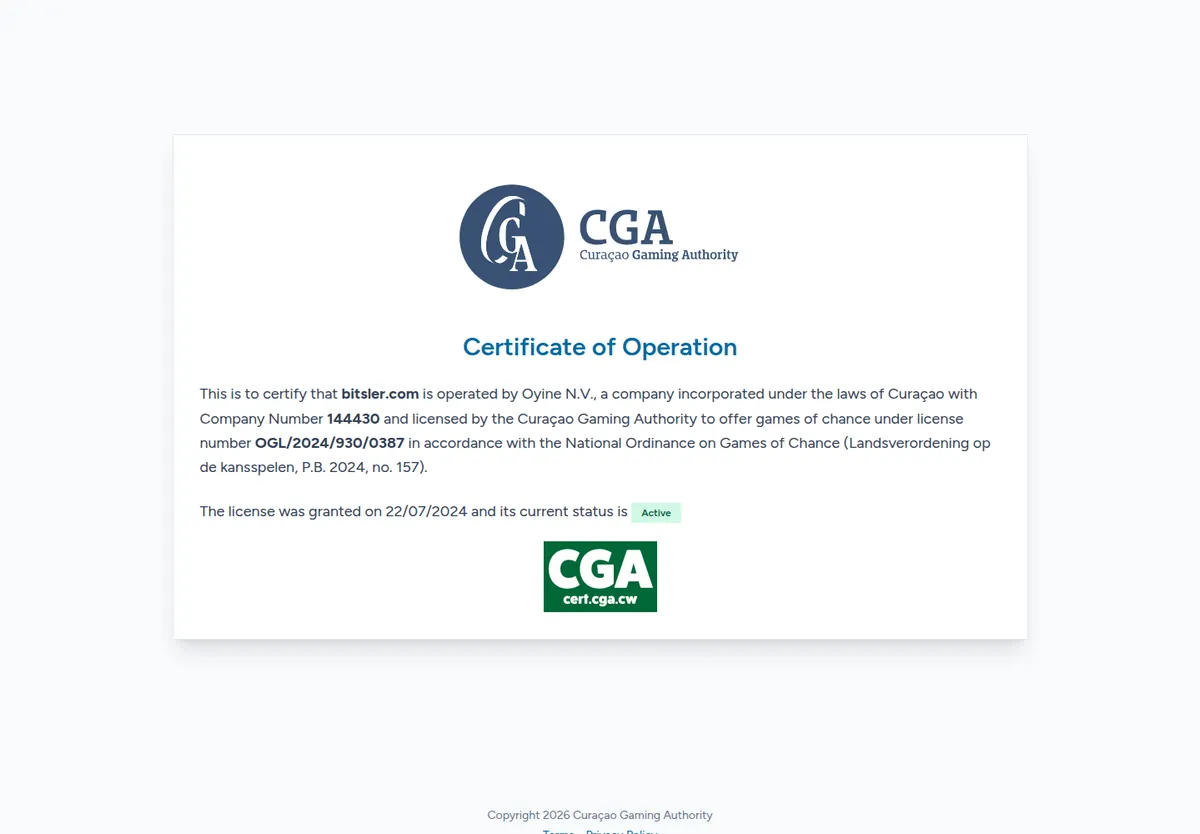
Bitsler.com is operated by Oyine N.V., company number 144430, under licence OGL/2024/930/0387, granted 22/07/2024 and shown as Active.
What a mismatch actually does
There is no single outcome, and knowing the three common ones is more useful than a general warning.
The send is refused before it leaves. The sending wallet or exchange checks the address format against the selected chain, sees that they cannot belong together, and declines. Nothing moves and nothing is lost. This is the best case, it is common, and it is why sending from a hosted exchange account has a safety property that sending from a self-custody wallet does not — a difference set out in full on how a deposit arrives. Which chains a cashier actually names is recorded per operator in the crypto casinos and their accepted chains.
The send succeeds onto a chain where nobody holds the key. Some chains share an address format. An address that is valid on one of them is valid on the others, so a transfer sent to a receiving address on the wrong shared-format chain confirms normally and lands at a place the receiving party never intended to have a balance. Recovering it requires the receiver to control the key on that other chain and to be willing to run a manual process. Some services will. Many will not, and none of them are obliged to.
The send succeeds onto the right chain but into an address that belongs to someone else. This is not a network problem at all — it is a copy-paste problem, an address book with a stale entry, or an address swapped between the copy and the paste. Networks do not distinguish between a stranger’s address and yours, because both are just valid strings.
In every one of these cases except the first, the transaction is on a public ledger, is confirmed, and is final. There is no chargeback layer under it. That is the same property that makes the route work without a bank, and it is not something a casino chose.
What each party can and cannot do once a transfer is confirmed — the bank, the exchange, the operator and the authority that issued its licence — is set out on the page about finality.
Why the casino’s support desk is not the answer
When a deposit does not appear, the instinct is to open a chat with the operator. In the mismatch cases above, that chat cannot help, and the reason is worth understanding rather than resenting.
The operator sees deposits that arrive at its addresses on the networks it monitors. A transfer that went to a different chain never appeared in its view of the world. From the operator’s side, nothing happened at all — not an error, not a pending item, simply nothing. There is no record to look up and no state to correct.
The one thing a support desk can genuinely do is tell you which networks that operator monitors, which is exactly the information needed before the send rather than after. Among the ten operators read here, none publishes a network list in its terms that could be cited. Two publish coin counts and a handful of headline tickers — Cloudbet forty coins with BTC, BCH, ETH, USDT, USDC and USDP named, and Rakebit fifteen with BTC, ETH, SOL, LTC, USDT and USDC named — but a ticker list is not a network list, and treating one as the other is precisely the substitution this page exists to warn against.
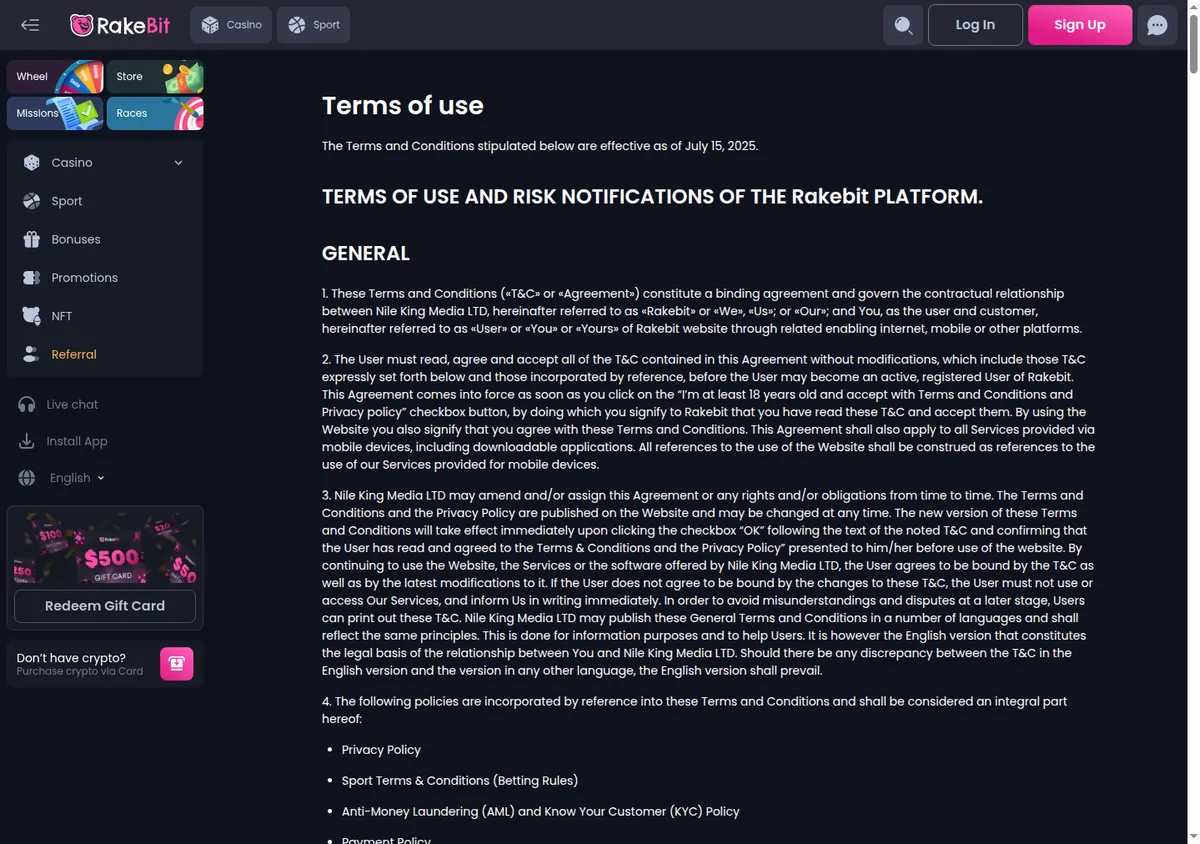
Clause 1 names Nile King Media LTD as the counterparty. Clause 4 folds four further documents into the same agreement — the privacy policy, the sports rules, the AML and KYC policy and the payment policy. Reading this page alone is not reading the contract.
Memos, tags and the deposits that arrive but do not arrive
A separate failure mode belongs to a handful of chains that route funds to a shared address and use an attached identifier to say which account the arriving balance belongs to. The identifier goes by different names depending on the chain: a memo, a tag, a note field.
Send to the shared address without it and the transfer confirms, the money reaches the receiving service, and nothing lands in any account. It is not lost in the way a wrong-chain transfer is lost — the receiver has it — but retrieving it depends entirely on that receiver running a manual reconciliation, which again is a courtesy rather than an obligation.
The field is presented as optional-looking, because it sits below the amount and is empty by default. On the chains that use it, it is not optional. If a deposit screen displays one, it is displayed because it is required.
The check that costs six seconds
None of this requires expertise. It requires reading two things next to each other before pressing send.
The first is the network named on the receiving side — in the casino’s deposit screen, usually in a dropdown or in small text above the address. The second is the network selected on the sending side, in the exchange withdrawal form or the wallet’s send screen. They have to be the same word. Not the same coin: the same network.
The second habit is to send a small amount first when the pair of endpoints is new, wait for it to appear, and only then send the rest. It costs one extra fixed transfer cost, which is a real amount of money and a completely rational price for confirming that a route works before committing to it. The fees page explains why that fixed cost is the number to think in.
What this page does not claim
It does not name a cheapest network in currency terms, because network fees move continuously and any figure printed here would be stale before it was read. What is stable enough to say is the ordering: transfers on Tron and Litecoin sit at the cheap end, Ethereum sits well above and moves with congestion, Bitcoin sits between the two and also moves.
It does not claim that any particular operator supports or refuses any particular network, because none of the ten publishes that list in terms we could read. And it reports no times in minutes for any of them, because this site holds no funded accounts and measures nothing. Everything above is either a property of public networks or a figure quoted from a published clause — the distinction is set out on how the figures are read.