
What the route costs
Three deductions, three different recipients, one of them the casino
The fee charged by a blockchain is not charged by the house, moves by the hour, and depends on a dropdown. The fee charged by the house appears in a quotable clause at 0 of the 10 operators read here, which is a finding rather than a gap.

| Casino | Coins listed | Ceiling on the way out | Licence | Visit |
|---|---|---|---|---|
| VaveOur pick | 6 | from 50,000 USDT split into instalments clause 8.8 | Curaçao Gaming Authority | Go to siteDetails |
| Bitcasino.io | not read | 1,000,000 USDT a week clause 6.10 | Curaçao Gaming Authority | Go to siteDetails |
| Empire.io | not read | not published | Anjouan Gaming Board licence bars NL | Go to siteDetails |
| Bitsler | not read | not published | Curaçao Gaming Authority | Go to siteDetails |
| Cloudbet | 40 | not published | Curaçao Gaming Authority | Go to siteDetails |
| CoinCasino | not read | 500,000 EUR a month clause 9.6 | Anjouan Gaming Board licence bars NL | Go to siteDetails |
| Rakebit | 15 | 10,000 EUR a day clause number not recorded | Anjouan Gaming Board licence bars NL | Go to siteDetails |
| Primedice | not read | not published | Government of Curaçao | Go to siteDetails |
| Stake | not read | not published | Curaçao Gaming Authority | Go to siteDetails |
| BetPlays | not read | 5,000 EUR a week clause 6.11 | not published | Go to siteDetails |


Separating the three makes all of them smaller
Between the amount shown in a casino balance and the amount that lands in a wallet there are three possible deductions. They are charged by three different parties, behave in three different ways, and are almost always experienced as one unexplained shortfall.
The network fee is paid to the blockchain. It exists because a transfer competes with other transfers for space in a block, and it goes to whoever produces that block. No casino receives any part of it, no casino can waive it, and it would be charged in exactly the same way on a transfer between two private wallets with no casino involved at all.
The operator fee is the house’s own deduction, or that of a payment provider working on its behalf. Unlike the network fee, this one is a business decision, it can be zero, and it is the one that belongs in a comparison of operators.
The conversion spread is not called a fee by anyone and functions as one. If a balance is denominated in a fiat currency and the transfer happens in a coin, something converts between them at a rate somebody chooses. The gap between that rate and the market rate is a cost paid without ever appearing as a charge.
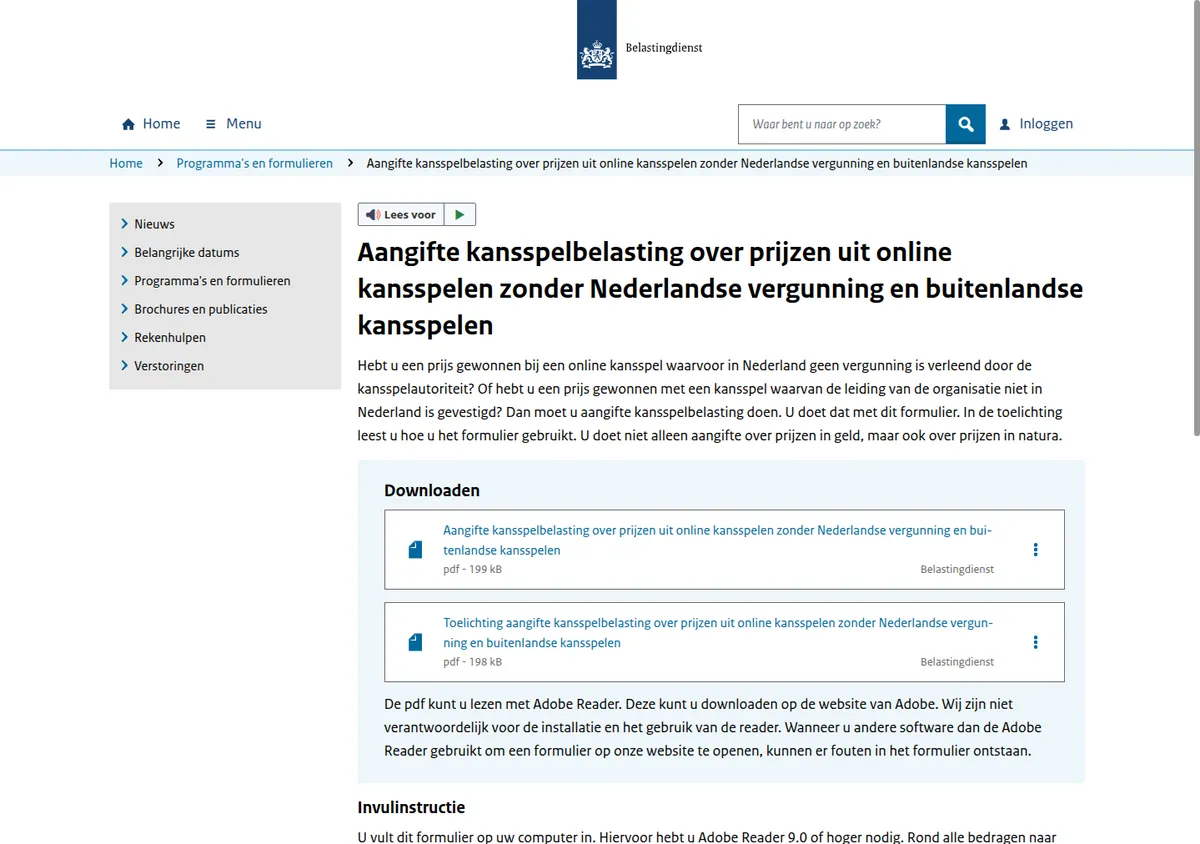
The tax authority names the case in its own words: a prize won at an online game for which no licence was granted in the Netherlands. The form exists because the player, not the operator, is the one who files it.
The network fee is a property of the chain you picked
The size of a network fee has nothing to do with the size of the transfer and everything to do with which chain it travels on and how busy that chain is at that moment.
The ordering between the common chains is stable enough to state. Transfers on Tron and on Litecoin sit at the cheap end. Ethereum sits well above them and moves substantially with congestion. Bitcoin sits between the two and also moves. These are orders of magnitude relative to one another, and that relationship has held long enough to be worth knowing. Because the ordering belongs to the chains rather than to any operator, it is stated as a general property and kept out of the per-operator columns of the crypto casinos and their coin lists.
What this site will not do is put a euro figure on any of them. Network fees move continuously, sometimes by a large multiple within a single day, and a number written into a page in August would be a false claim by October while looking exactly as authoritative as it did on the day it was typed. Comparison pages are full of such numbers, all of them dated, none of them labelled as dated.
The consequence for anyone actually moving money is simple: the network dropdown is the largest cost lever in the entire route, and it is usually the control people click through fastest. Choosing it deliberately, when the choice exists, saves more than any bonus term does. It also has to match the address on the other side, which is the subject of the networks and addresses page.
There is no operator fee this table can compare
This is the finding of the page, and it is close to a blank one.
Across the ten operators read here — Vave, Bitcasino.io, Empire.io, Bitsler, Cloudbet, CoinCasino, Rakebit, Primedice, Stake and BetPlays — no deposit fee or withdrawal fee could be found in the published terms in a form that could be quoted with a clause number and set beside the other nine rows. There is therefore no fee column in the comparison table on this site, and adding one would be dishonest: a column that nearly every row would fill with not published exists only to make a page look thorough. A comparison needs two figures to compare, and this one has nowhere near two.
It has to be said in the direction that is uncomfortable as well as the direction that is easy. Both are printed on the row that pays, which happens to be the least flattering way they could be written.
The rule has a second edge, and the same row is where it showed. That licence cell read no number given from 25 August 2026 until 2 September 2026, when the Curaçao register was searched a second time and returned OGL/2024/1676/0905, held by Latcas B.V. and recorded Active. A blank means looked for and not found, in both directions, and a blank that is never revisited quietly turns into a claim.
What the blank does not mean is that these operators charge nothing. Silence about a fee is not a promise of zero, and reading it as one would be exactly the error this site exists to avoid. It means the amount is unknowable from outside, and the place it becomes knowable is the withdrawal form of a funded account, at the moment before confirming — which is also the last moment at which it can be refused.
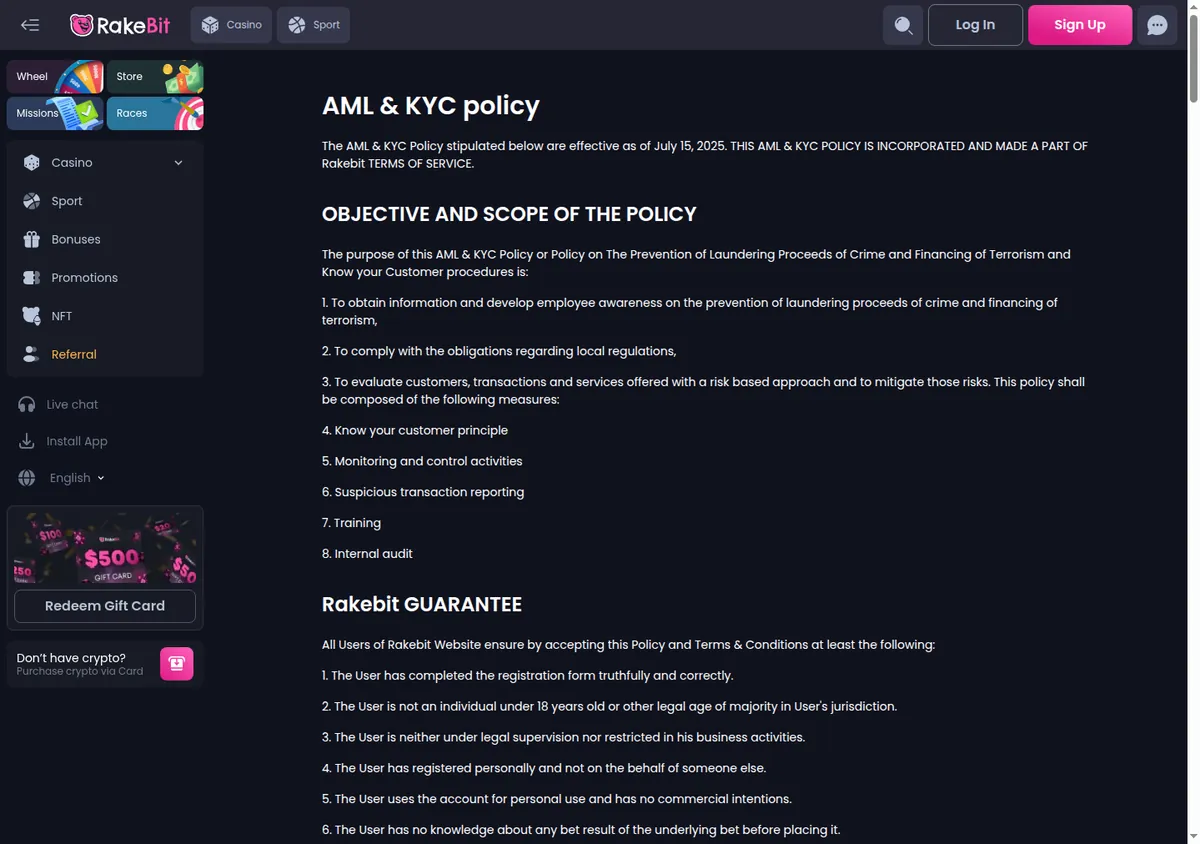
The policy sets out eight measures, from the know-your-customer principle to internal audit, and makes the player warrant that they are of age, registered personally and not acting for someone else. No amount is named at which documents start being asked for.
Fixed costs make small movements expensive
Because both the network fee and any per-transaction operator fee are largely fixed rather than proportional, the share of a transfer they consume rises sharply as the transfer gets smaller.
The arithmetic is the whole argument. A fixed deduction that costs three per mille of a large withdrawal costs three per cent of one a tenth the size, and thirty per cent of one a hundredth. The clause is the same, the deduction is the same, and the effect is unrecognisably different. Nobody expects to lose a third of a payout to logistics, because losses are supposed to happen in the game.
From which follows the only piece of practical advice on this page: fewer and larger movements cost less than more and smaller ones, in both directions. Ten withdrawals of a small amount pay ten fixed costs. One withdrawal of the total pays one.
And the counter-argument, which is not a footnote. A balance left in an account to be withdrawn later is a balance that remains available to be played. For anyone who recognises that as a risk in their own case, the more expensive pattern of frequent small withdrawals is the right one, and the money it costs is buying something worth more than the money. That is a decision about play. It should be made as one, not smuggled in as a fee optimisation.
Where the exchange sits in the chain
One deduction gets missed entirely because it happens before the casino is involved. Buying a coin on an exchange has a cost, and withdrawing it from that exchange to a private address has another, set by the exchange rather than by the network or the house.
For someone whose whole route runs from euros to an exchange to a casino and back again, that is four fixed costs per round trip, only one of which any casino controls. Comparing operators on fees, if the figures existed, would be comparing the smallest of them.
That leg carries more than a price. Who is allowed to sell a coin to a Dutch resident, and what information the transfer rules attach to the send, is set out on the page about buying the coin.
What this page does not claim
It prints no amounts in euros, dollars or coins for any fee, network or operator, because every one of them moves and this site does not date its figures.
Everything above is either a stable property of public blockchains, stated as an ordering rather than a price, or a statement about what the operators publish — which, on the subject of fees, is nothing at all. The rules behind that distinction are on how the figures are read.