
Step one of the route
From a wallet to a casino balance: what a deposit passes through
A deposit modal shows an address and a QR code and implies that the hard part is copying correctly. The hard part is upstream of it, in the 2 or 3 places where the coin has to come from somewhere before it can go anywhere.

| Casino | Coins listed | Ceiling on the way out | Licence | Visit |
|---|---|---|---|---|
| VaveOur pick | 6 | from 50,000 USDT split into instalments clause 8.8 | Curaçao Gaming Authority | Go to siteDetails |
| Bitcasino.io | not read | 1,000,000 USDT a week clause 6.10 | Curaçao Gaming Authority | Go to siteDetails |
| Empire.io | not read | not published | Anjouan Gaming Board licence bars NL | Go to siteDetails |
| Bitsler | not read | not published | Curaçao Gaming Authority | Go to siteDetails |
| Cloudbet | 40 | not published | Curaçao Gaming Authority | Go to siteDetails |
| CoinCasino | not read | 500,000 EUR a month clause 9.6 | Anjouan Gaming Board licence bars NL | Go to siteDetails |
| Rakebit | 15 | 10,000 EUR a day clause number not recorded | Anjouan Gaming Board licence bars NL | Go to siteDetails |
| Primedice | not read | not published | Government of Curaçao | Go to siteDetails |
| Stake | not read | not published | Curaçao Gaming Authority | Go to siteDetails |
| BetPlays | not read | 5,000 EUR a week clause 6.11 | not published | Go to siteDetails |


The modal is the last step, not the first
The deposit screen at a crypto casino is one of the simplest interfaces in online payments. It shows an address, a QR code, sometimes a network selector, and a note about a minimum. There is nothing to fill in and nothing to sign. It looks like the whole process.
It is the fourth step of five. Ahead of it sit the questions of where the coin comes from, which coin it is, and which network it will travel on. Behind it sit confirmations and crediting, neither of which the player controls. Laid out in order, a deposit looks like this: acquire the coin, choose the network, send to the address, wait for confirmations, see the balance credited. Only the middle one happens on the casino’s site.
That imbalance is why deposit problems almost never look like deposit problems. They look like a balance that has not appeared, and the natural response is to contact the casino — which is frequently the one party in the chain that cannot see what went wrong, because the part that went wrong happened before the money reached it.
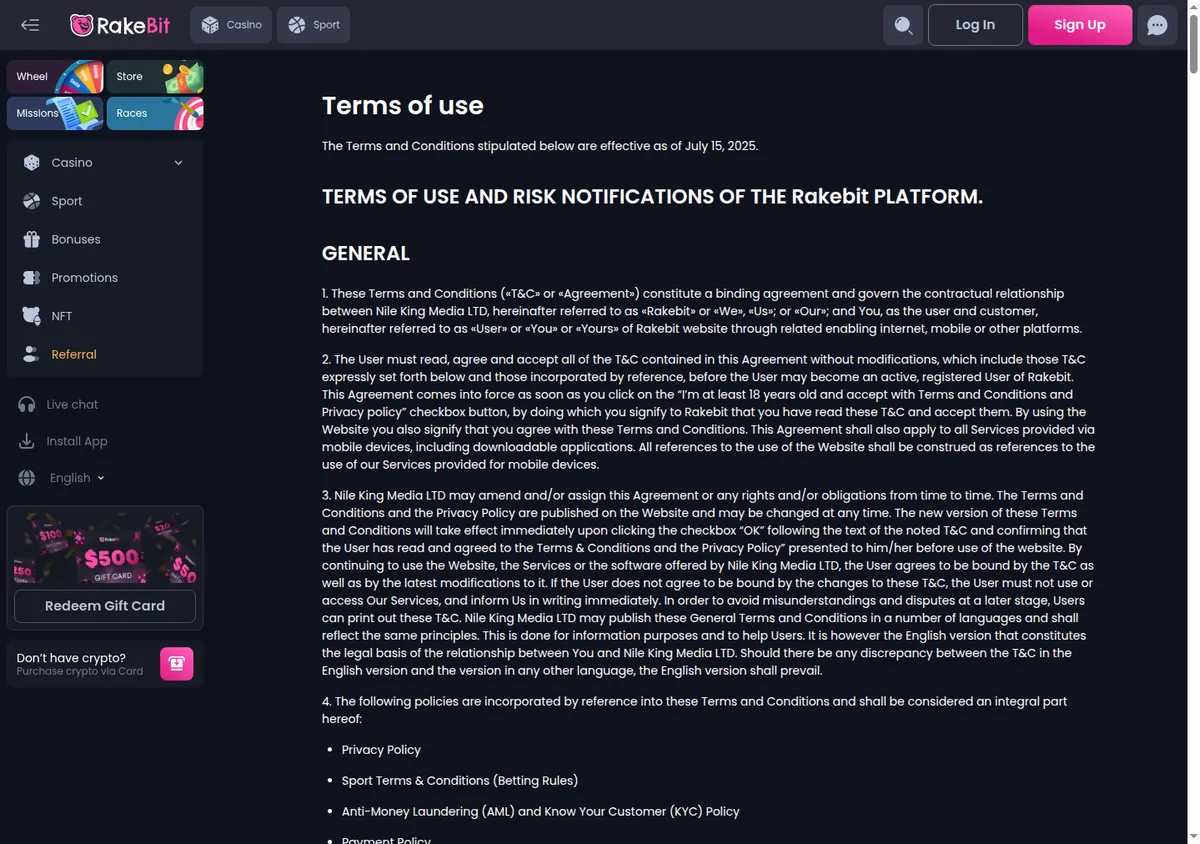
Clause 1 names Nile King Media LTD as the counterparty. Clause 4 folds four further documents into the same agreement — the privacy policy, the sports rules, the AML and KYC policy and the payment policy. Reading this page alone is not reading the contract.
Where the coin comes from changes what the send looks like
There are two common starting points and they behave differently at exactly the moment it matters.
From an exchange account. The coin was bought with ordinary money, sits in a hosted account, and leaves it through a withdrawal form. The exchange picks its own fee, often applies its own minimum, and — critically — decides for itself which networks it will send on. An exchange that does not support a given chain simply will not offer it in the dropdown, which is safer than offering it wrongly, but it also means the network available at the sending end may not be the network offered at the receiving end. That mismatch is discovered in the dropdown, before anything moves, and costs nothing if noticed there. Which of the two routes an operator supports is recorded per row in the best crypto casino list.
From a self-custody wallet. The coin sits under a key held by the person sending it. There is no withdrawal form and no support desk, and there is also no second party to catch an obviously bad instruction. A self-custody wallet will broadcast whatever it is told to broadcast, on any chain it supports, to any address that passes a format check, and nothing downstream of that broadcast can take it back.
Neither is better as a general matter. The relevant difference for a deposit is that the exchange route has one extra pair of eyes and one extra set of restrictions in it, and the self-custody route has neither. A person who has used one of them for a year usually has habits that do not transfer to the other.
Confirmations are the network’s business, not the casino’s
After the send, the transfer sits in the network’s queue until enough blocks have been built on top of it for the receiving side to treat it as settled. How many blocks counts as enough is a policy set by the receiver, and different receivers pick different numbers for the same chain.
Two properties of this stage are worth knowing, and both belong to blockchains rather than to any operator. First, chains differ enormously in how quickly blocks appear: some settle a transfer in the time it takes to read this paragraph, others take an order of magnitude longer, and the slowest common ones are slower still. Second, when a network is busy, a transfer that paid a low fee waits behind transfers that paid more. That is not a fault and not a queue anyone can jump on a player’s behalf.
What this means practically is that a deposit which has not appeared is, most of the time, a deposit that is still confirming, and the place to look is a block explorer for the chain in question rather than a support chat. The transaction either exists on the network or it does not, and that question has a public answer that neither party has to be trusted for.
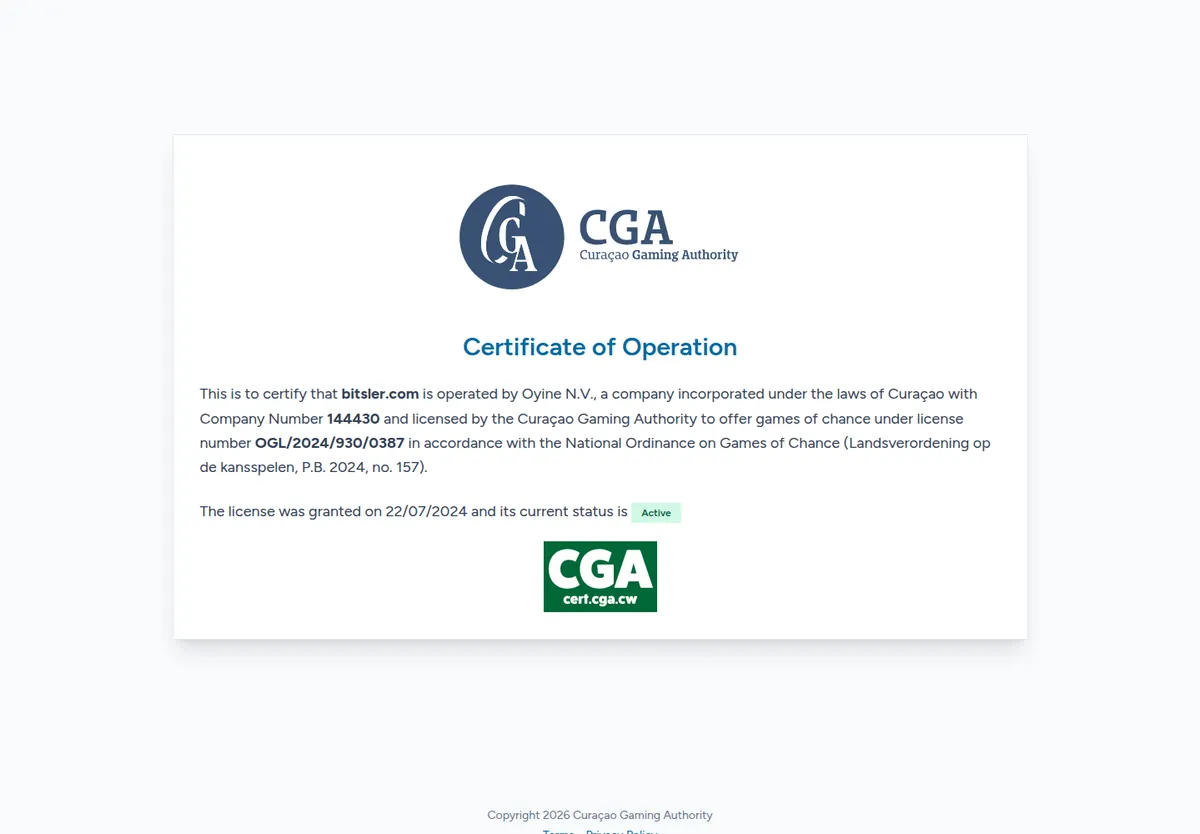
Bitsler.com is operated by Oyine N.V., company number 144430, under licence OGL/2024/930/0387, granted 22/07/2024 and shown as Active.
Crediting is where the operator’s rules start
Once the required confirmations exist, the operator credits the balance, and from that point onward every rule that applies is the operator’s own. This is the boundary that matters for everything else on this site: before crediting, the facts are properties of a network; after crediting, they are clauses in a document.
All ten operators read here publish terms in which the relevant clauses could be located and cited, and every figure printed on this site comes out of one of those documents. What differs between them is how much the document actually settles. It also states, in clause 8.7, that documents may be demanded before any payout at its own discretion — no amount, no trigger, fourteen days to comply.
The same row carries the correction that runs the other way. Until 2 September 2026 its licence cell read no number given, because the reading of 25 August found a jurisdiction and no identifier; searched again, the Curaçao register returned OGL/2024/1676/0905, held by Latcas B.V. and recorded Active. A blank here has always meant looked for and not found, and that is the sort of thing a second look is for.
A minimum is not the same as a sensible amount
Most deposit screens name a minimum, and it is usually small. It is a technical floor — below it the transfer costs more to move than it is worth — and it should not be read as a suggestion.
Because the costs attached to moving a coin are largely fixed per transfer rather than proportional to the amount, a small deposit loses a much larger share of itself in transit than a large one does. The same total, sent in ten pieces, pays roughly ten fixed costs instead of one. Nothing in any operator’s terms says this, and no deposit screen mentions it, because the fixed cost is largely charged by the network rather than by the house. The fees page works through where each deduction goes.
The counter-argument is real and belongs here rather than in a footnote. Money that sits in a casino balance is money that can be played, and depositing in larger, less frequent amounts puts more of it within reach. Anyone for whom that is a live concern should treat the more expensive pattern as the correct one. That is a decision about play, not about payments, and the two should not be traded off silently against each other.
What cannot be established from outside
Whether a given operator credits fast or slow, whether its deposit screen displays a fee before confirmation, and whether it silently rejects a network it does not support are all things that can only be seen from inside a funded account. This site does not hold funded accounts and does not report on any of them.
What can be established is what the operators publish, and what they publish about deposits is thin. Deposit fees could be read for none of them. The coin lists page sets out exactly which of the ten publish what.
One question sits before all of these and belongs to the reader rather than to the operator: what happens between a euro in a Dutch bank account and a coin at the cashier, which is set out under iDEAL and euros. What the balance is worth once it arrives is a separate question again, taken up under stablecoin or volatile coin.