
The last gate
Documents are asked for on the way out, and nobody sees them coming
2 of the 10 operators publish an amount at which documents get demanded. The other 8 publish a rule with no amount in it. The difference between an amount and a rule is the difference between a threshold and no threshold at all.

| Casino | Coins listed | Ceiling on the way out | Licence | Visit |
|---|---|---|---|---|
| VaveOur pick | 6 | from 50,000 USDT split into instalments clause 8.8 | Curaçao Gaming Authority | Go to siteDetails |
| Bitcasino.io | not read | 1,000,000 USDT a week clause 6.10 | Curaçao Gaming Authority | Go to siteDetails |
| Empire.io | not read | not published | Anjouan Gaming Board licence bars NL | Go to siteDetails |
| Bitsler | not read | not published | Curaçao Gaming Authority | Go to siteDetails |
| Cloudbet | 40 | not published | Curaçao Gaming Authority | Go to siteDetails |
| CoinCasino | not read | 500,000 EUR a month clause 9.6 | Anjouan Gaming Board licence bars NL | Go to siteDetails |
| Rakebit | 15 | 10,000 EUR a day clause number not recorded | Anjouan Gaming Board licence bars NL | Go to siteDetails |
| Primedice | not read | not published | Government of Curaçao | Go to siteDetails |
| Stake | not read | not published | Curaçao Gaming Authority | Go to siteDetails |
| BetPlays | not read | 5,000 EUR a week clause 6.11 | not published | Go to siteDetails |


The check is at the exit, and that changes everything about it
At a licensed operator in a regulated market, identity documents are usually collected before the first stake. The check is a door, it is at the entrance, and everyone meets it in the same place.
At the ten operators read for this site, the sequence is inverted. Registration is short, deposits credit, play begins, and the document request — when it comes — comes when money tries to leave. That single difference in ordering produces the whole popular impression that these operators do not verify anybody. They do. They verify later, and later means after the balance already exists.
The practical consequence is that verification stops being an administrative step and becomes a condition on a payout. A document request that arrives at registration costs an afternoon. The same request arriving against a pending withdrawal costs an afternoon and holds the money while it is answered.
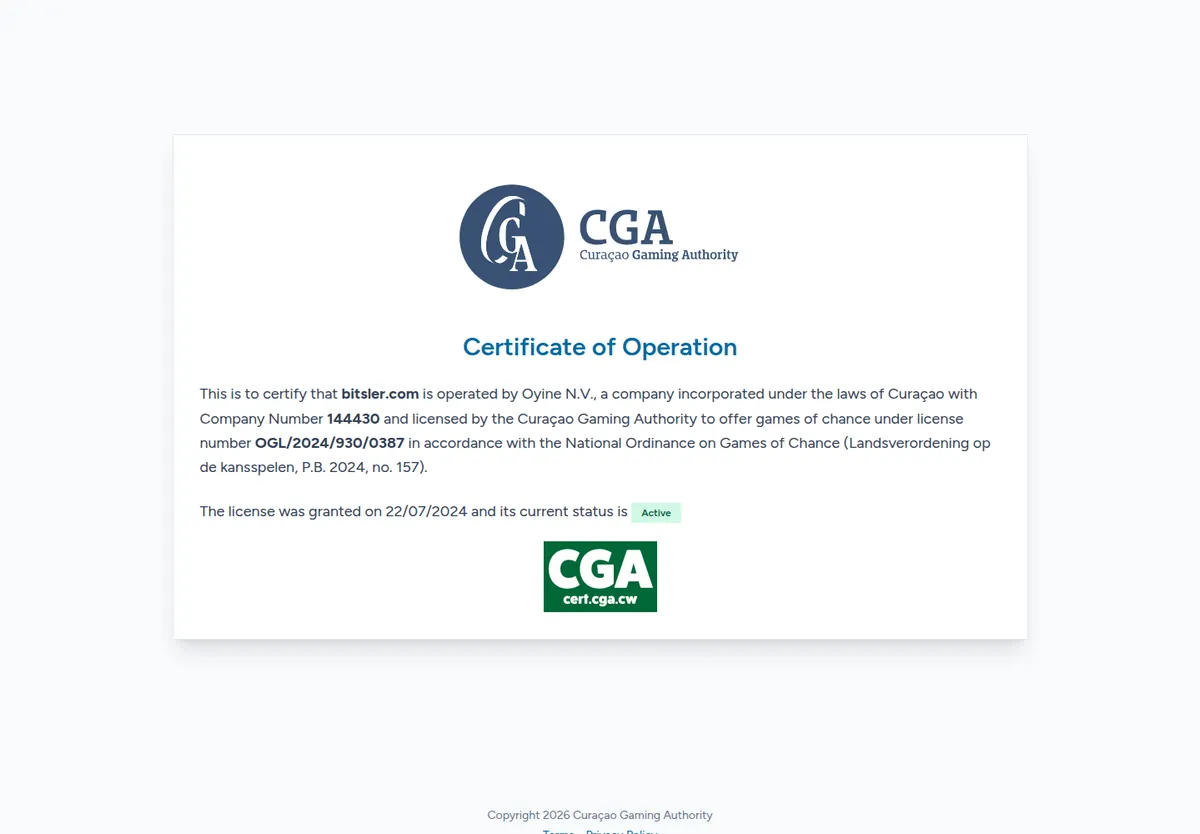
Bitsler.com is operated by Oyine N.V., company number 144430, under licence OGL/2024/930/0387, granted 22/07/2024 and shown as Active.
Two operators publish an amount
Bitcasino.io names 2 500 EUR, in clause 6.6.
Empire.io names 2 000 USDT, in clause 5.4.
These are thresholds, and a threshold has properties a rule does not. It can be read before depositing. It can be planned around. If it is applied at a lower figure, there is a written sentence to point at, which is not a guarantee of anything but is considerably better than nothing.
It is worth noting how close these two figures are to each other, and how far both are below the withdrawal ceilings published by anyone. Verification is not a barrier reserved for large wins. Both of these amounts are reachable in an ordinary session, which is the real reason the ordering matters: for most accounts that ever request a payout of any size, the document request is the gate they actually meet. Both figures sit beside the ceilings they fall short of in the crypto casinos and their verification figures.
Eight publish a rule instead
Bitsler states a discretionary verification rule in clause 4.3. Cloudbet states one in clause 18.1.1. CoinCasino states one across clauses 5.2 and 9.3. Stake states one in clause 4.8. BetPlays states one in clause 4.3. Vave states one in clause 8.7. Rakebit and Primedice state the same kind of rule without a clause number that could be cited.
The wording differs from operator to operator, and the substance is consistent: documents may be requested when the operator considers it necessary. No amount is named. No trigger is described in a way that could be checked from outside.
This is where the most persistent misreading in the whole industry lives. A discretionary rule is not a threshold whose number is confidential. It is a statement that there is no number. The two are not close: one says the check happens above a figure, the other says the check happens when someone decides it should.
Anywhere you find a confident figure attached to one of those eight operators — a specific amount above which they are said to verify — that figure did not come from the terms, because the terms do not contain one. It came from a comparison page, which took it from another comparison page. Nothing about a number’s appearance records where it came from, which is exactly why every figure on this site carries a clause.
In the comparison table on this site, the column headed with an amount reads not published for seven of those eight, and case by case on the eighth. The heading names an amount, so a blank in it means no amount is published — not that no rule exists. The rules exist and are cited above.
That is a rule, not a threshold, and it is written down as one. Its cell in the table says case by case, because no amount attaches to it: a first withdrawal of fifty euro sits under exactly the same clause as a withdrawal of fifty thousand.
One real data point sits beside the clause. On 28 August 2026 a balance of roughly 5 000 USDT was withdrawn from Vave and no document was requested. It shows that a withdrawal of that size can pass without a request; it does not show that the next one will.
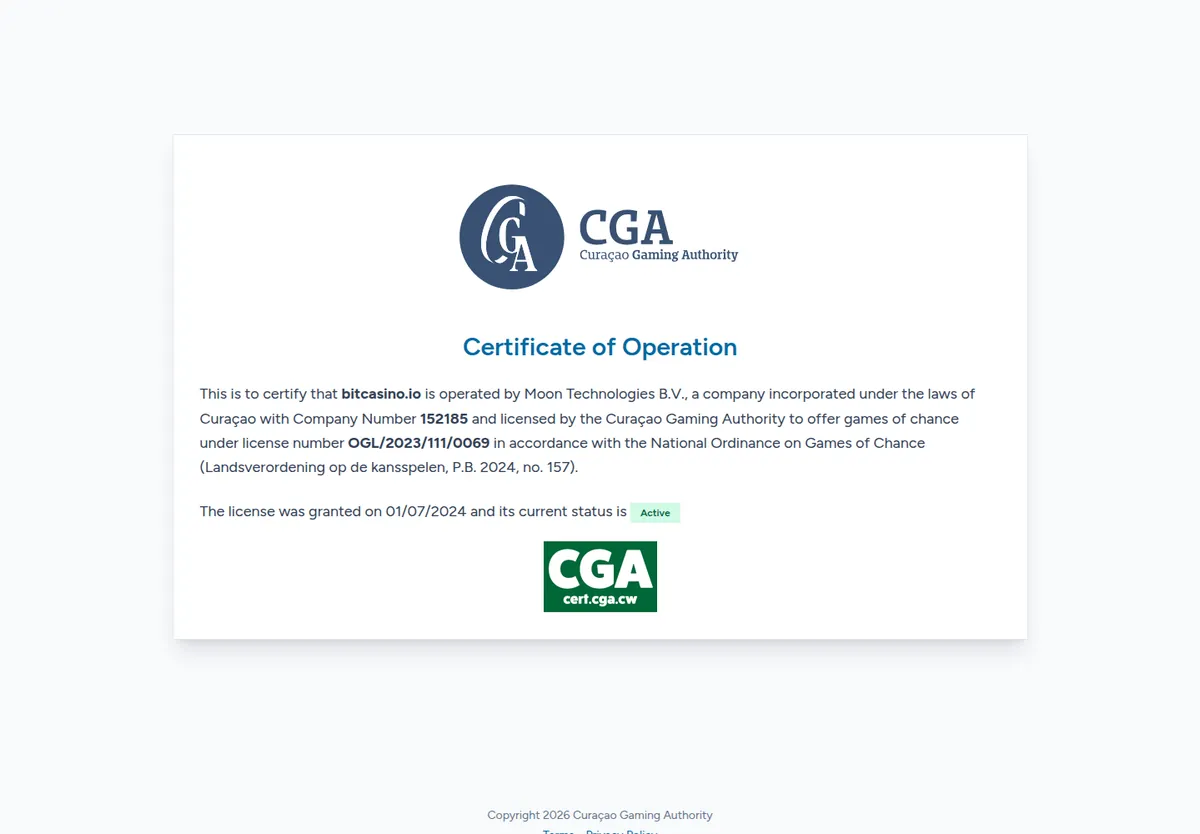
The certificate names the company behind the brand: Moon Technologies B.V., company number 152185, licence OGL/2023/111/0069, granted 01/07/2024, status Active. This is what a licence number is worth — it resolves here, or it does not resolve at all.
What a document request typically covers, and what it costs to ignore
Across operators of this kind the requested set is broadly similar: proof of identity, proof of address, and in some cases proof of the source of funds when an amount is large or a pattern is unusual. This is described here in general terms because the specific list is not published in a citable form by these ten.
What is worth understanding is the shape of the risk rather than the paperwork. A withdrawal held pending verification is not refused; it is paused. The problem with a pause is that it is open-ended when no deadline is published, and that a balance which remains in an account remains playable. Money that cannot leave and can still be staked is in a worse position than money that simply cannot leave.
One of the ten publishes a deadline for responding to a request: Vave gives fourteen days in clause 8.7. The other nine publish no deadline in a form that could be quoted here, and that absence is recorded as an absence rather than converted into an assumption in either direction.
Why this belongs on a site about payment routes
Verification is often filed under regulation, which is a different subject and one this site does not cover. It appears here because of where it sits physically in the route: it is the last thing between a balance and a wallet, downstream of the coin, the network, the fee and the ceiling.
Everything upstream of it can be done correctly — right coin, right network, right address, an amount well under any published ceiling — and the money still does not move, because a document request is outstanding. In a chain of dependencies, the last link is the one that determines the outcome, and this is the last link.
The gate immediately before it is the ceiling, and the two are met together on any large payout, since every published verification amount here sits far below every published ceiling. The four published ceilings, the one instalment threshold and the five blanks are on the ceilings page.
What this page does not claim
It does not claim that any of the ten has demanded documents from anyone, refused a payout, or applied a clause in any particular case.
It does not claim that a discretionary rule is applied harshly, or leniently, or at any particular amount. It claims that no amount is published, which is a fact about the document. And it does not suggest anything about avoiding, delaying or working around a verification request — the point of reading these clauses in advance is to know where the gate is, not to look for a way past it. The rules behind every figure and every blank are on how the figures are read.