
A contract in five parts
Reading the terms page here is not reading the contract
Rakebit publishes a coin count of 15, which puts it among the 3 operators here that publish one at all. Clause 4 of its terms then folds 4 further documents into the same agreement, so the page a reader lands on is roughly a fifth of what they are agreeing to.
Fifteen, named
This row is one of two published counts, with BTC and ETH at the front of the list, then SOL, LTC, USDT and USDC.
Fifteen is the smaller of the two published counts and it is still a published list, which is the distinction this site cares about. A count can be checked and can be wrong. A row of coin logos falls short on both counts, and it is what the majority of this market offers instead — the coin lists page sets the three counts against the seven blanks.
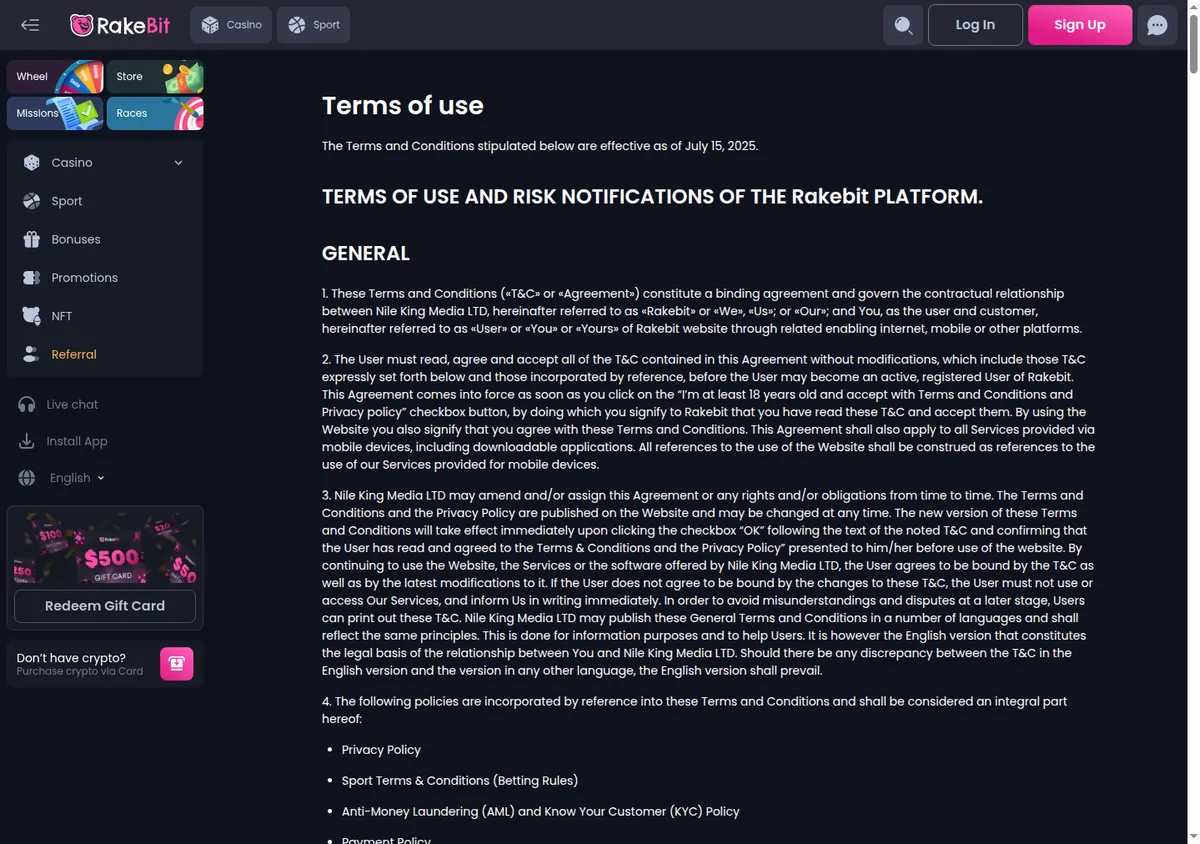
Clause 1 names Nile King Media LTD as the counterparty. Clause 4 folds four further documents into the same agreement — the privacy policy, the sports rules, the AML and KYC policy and the payment policy. Reading this page alone is not reading the contract.
Clause 4, and the shape of the contract
Clause 1 names the counterparty and clause 4 quietly extends the contract, and the second of those is the one worth noticing. Four separate policies join the agreement by reference alone, and the rules that govern a payout are split across them.
This is worth pausing on, because it changes what due diligence means here. A reader who opens the terms page, reads it carefully and closes it has read one of five documents. The provisions that decide what happens to a withdrawal live partly in the other four, and the AML and KYC policy in particular is where the identity rules sit rather than in the terms themselves.
Where the identity rule actually lives
Reading the AML and KYC policy costs a few minutes, and it is the wrong document to skip: the page most readers open is the page least likely to answer this question.
An amount is the one thing that policy withholds. Documents may be requested when the operator considers it necessary, and the request stays unpredictable at every balance. Eight of the ten write their rule this way, and the verification page compares all ten.
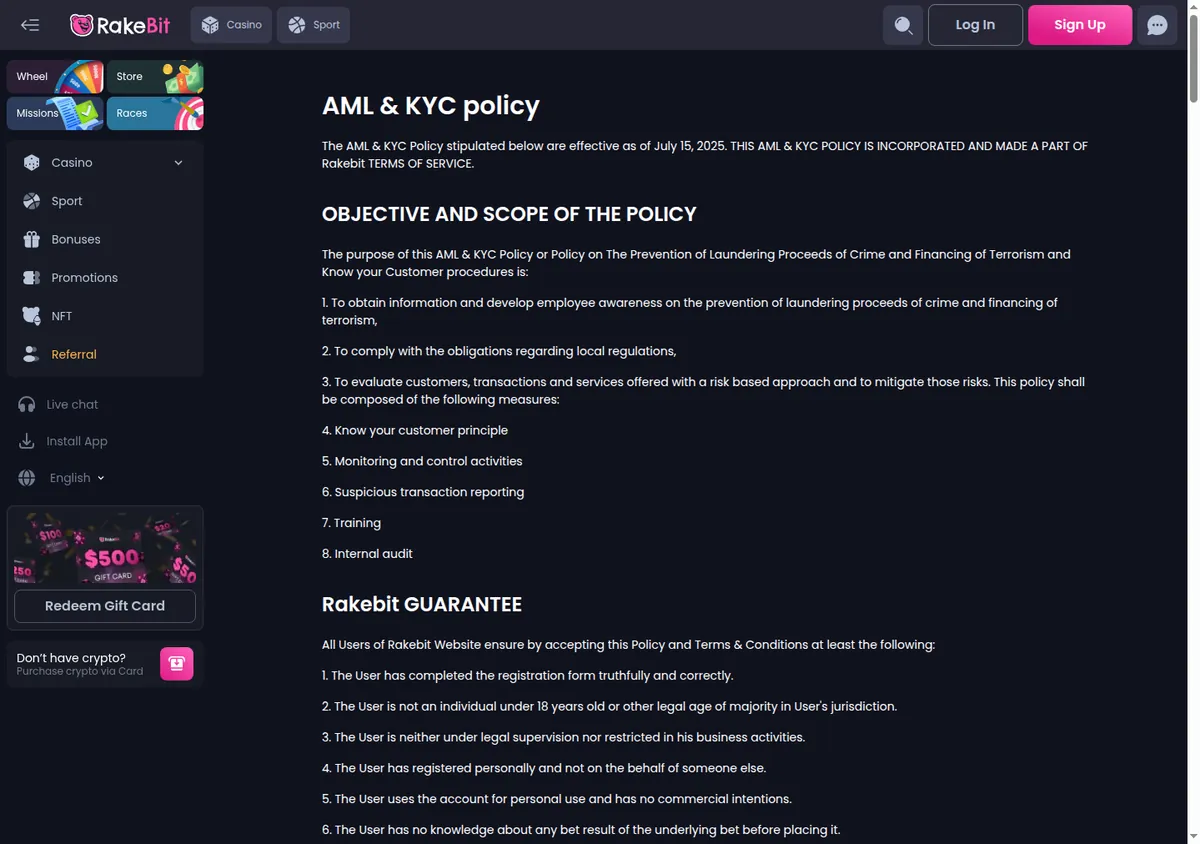
The policy sets out eight measures, from the know-your-customer principle to internal audit, and makes the player warrant that they are of age, registered personally and not acting for someone else. No amount is named at which documents start being asked for.
The ceiling, and the clause number that is missing from our notes
A withdrawal ceiling is in these documents, and it is worth reading in the operator's own words: “You may only withdraw the maximum amount of Euro 10,000 (or the equivalent in your Account currency) in any 24 hour”. Ten thousand euro a day, in the terms of use.
What is not here is the number of the clause that sentence sits in. It was not written down when the document was read, so the table prints the figure and says, in the cell, that the clause number was not recorded. That is the honest version of the state we are in. The alternative — leaving the cell empty — would have said Rakebit publishes no ceiling, and the sentence above is proof that it does.
The same reading also noted a second limit on this document, fifty thousand euro over thirty days, without capturing its wording. It is not printed as a figure for that reason, and it matters because over a month it is the tighter of the two: ten thousand a day does not add up to three hundred thousand here.
Three other operators in this set publish a ceiling, all three with a clause number attached, and the ceilings page sets the four figures against the five operators that publish nothing at all.
The Anjouan condition
Rakebit operates under ALSI-202602030-FI2 from the Anjouan Gaming Board. Both are printed here as found, and the licence cell is marked so the contradiction is visible before a deposit rather than during a dispute. The Dutch position is settled independently of either document, by the register described on the Cruks page.